
There seems to be an inbuilt timetable in what is now known as the “news cycle” which decrees that every few months George Carey pipes up with some comment or other and it is widely reported. One segment of the population nods, another rolls their eyes and we all move on. This phenomenon in no way seems to rest on how newsworthy his comments are.
This week’s story perfectly matches this pattern. We learn from that George Carey thinks the church “is one generation away from extinction”. This is not exactly what he said, or rather is not at all what he meant, when you read the quote in context. You can do so for yourself by downloading the PDF here. He did not intend it as a prophecy or an assessment of the current state of the church, but a reasonably factual, not time specific statement that if the next generation don’t come to church, it won’t last. In that sense, the church is always one generation away from extinction. It's his oft repeated way of hammering home the importance of youth and children’s work.
So why was something as bland and seemingly non-newsworthy is this covered so widely? The narrative of of inevitable church decline is of course a nice neat one, fitting pleasingly with the UK sense of itself as thrusting modern secular democracy, throwing off the shackles of superstition to be led instead by the light of science. To have this narrative confirmed by a former Archbishop with a talent for riling up the readers only makes it more attractive.
The narrative has some truth in it. Mainline church attendance has been in reasonably steady decline, and the percentage of those self identifying as Christian dropped in the last census from 72% in 2001 to 59% in 2011.
However, this isn’t the whole story. Grace Davie, the eminent sociologist of religion, has long spoken of the change in the church as not so much outright and straightforward decline, but an analogous to a move from a large, conscripted army to a much smaller professional one. She is essentially saying that in the past Christianity was something you might “opt out” of, but family, institutions and social pressure meant that unless you actively chose not to, you would end up in the church. What we are instead seeing is Christianity as “opt in”. In many churches around the country large proportions of the adult members of the congregation are converts, who made a conscious decision, often following Alpha or similar courses. They are not there by default, and as such tend to be more committed.
The implication of this is that perhaps the numbers of Christians, and by that I mean those for whom their faith, is a central, active defining factor in their lives have not declined quite so much after all. What we are seeing is a loss of nominal Christianity. Jesus of course, was not overly keen on those who put on religious language but at heart were “lukewarm” about God.
This week the team at Ipsos MORI reveal some new data analysis which lends this more nuanced and positive narrative some support. As part of a much broader project on generational analysis of the British Social Attitudes data, they have discovered that something interesting is going on with generation Y. Generation Y is the term used for those born between 1980 and 2000. If you ask them a straight question about religious affiliation: “do you regard yourself as belonging to any particular religion?” the data fits the popular narrative- generation Y are less likely than any prior generation to say yes. (The biggest drop, interestingly, is between the prewar generation and baby boomers, whereas generation Y are only slightly less likely to say yes than generation X).
.jpg)
If however, you ask them a question that reveals deeper commitment: “how often nowadays do you attend services or meetings connected with your religion?” the picture is a very different one. From what we can currently see generation Y, over the last 5- 7 years are increasingly likely to attend services or meetings once a month or more. In 2011, they were more likely than either generation X or the baby boomers to do so, and very nearly as likely as the prewar generation. They are therefore, the generation with the smallest proportion of nominal religious believers.
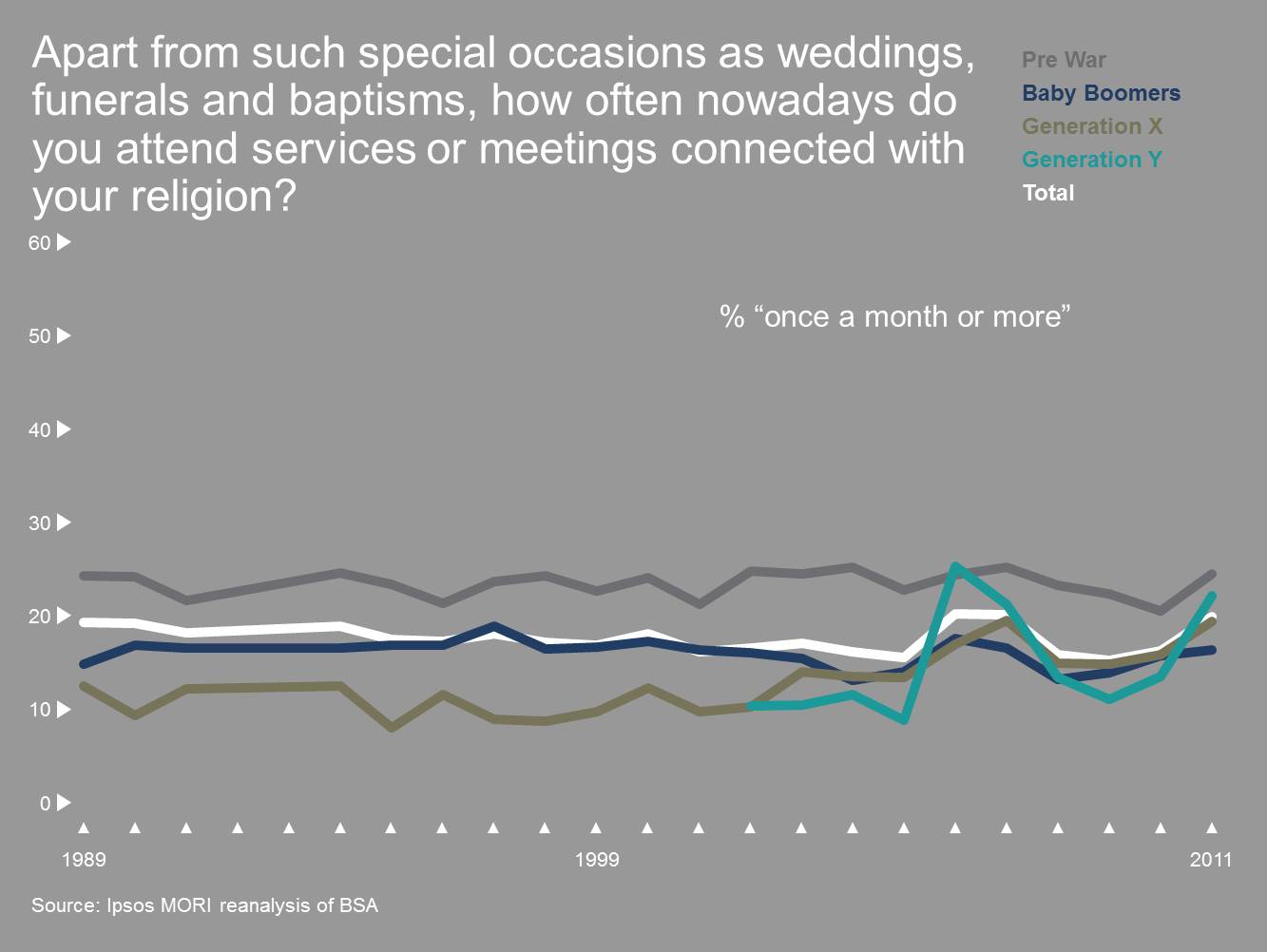
Data on generation Y is still emerging as some members of it are still too young to take part in surveys. Immigration may also play a part in these results, and they are certainly no reason for the church to become complacent about the need for growth. However, this study indicates that not only is the media narrative of the decline of Christianity a pretty oversimplified one, but that if current trends continue it seems less likely that the church will be extinct at least in this, Y generation.
Elizabeth Oldfield
Image from wikimediacommons.org available in the public domain.


