
Madeleine Pennington reflects on the life and unassuming faith of Dolly Parton. 27/08/2026
Dolly Parton has died aged 80, and it seems everyone has a tribute to pay. Individuals and institutions as wide–ranging as Donald Trump, Blue Labour, the British Royal Family, Eminem, and the Empire State Building have all marked her passing.
What was it about Dolly that we all loved – “will always love” – so much?
It goes without saying that she was exceptionally talented. She had a beautiful voice and was an extraordinary songwriter. She was performing on television by the age of ten, and famously wrote ‘I Will Always Love You’ and ‘Jolene’ on the same day in 1973. Her discography spanned some of the most iconic tracks of the last century. She was one of the best–selling music artists of all time.
Yet more than her musical success, her character moved people. Born into a poor but loving family near the Great Smoky Mountains in East Tennessee, her first home was a one–room cabin, and her father was an illiterate tobacco farmer (she claimed he had to pay the doctor who delivered her with a bag of cornmeal). She spoke and sang movingly of this humble background. It gave her a natural relatability. She was notoriously funny, self–deprecating, warm, and kind. And as RuPaul proclaimed following a 2020 interview with her for Marie Claire, “Let’s get one thing out of the way: Dolly Parton is exactly how you’d hope for her to be – frankly, even better.”
Nor was this just an interview persona. Throughout her dazzlingly successful career, her compassion for those on the margins also inspired a truly formidable philanthropic record. Her much–celebrated book gifting programme, Imagination Library, was founded in 1995 and has since distributed more than 300 million books worldwide. The UK operation alone has gifted 7 million books since 2008. Considering the total number of children living in the UK (as of 2026) is an estimated 12.6 million, these are staggering figures. She also donated to (and raised money for) medical causes, including HIV/Aids–related charities, cancer research, and a $1 million donation to the early development of the Moderna vaccine against Covid–19.
This celebrated character – these gifts – were formed at the deepest level by her Christian upbringing, and continued Christian faith. As in the words of her nephew announcing her death, “sadness lies with us, not with Dolly. Dolly has lived in the light, and is in the arms of Jesus”. She was the granddaughter of a Pentecostal pastor, and this spirituality, which she made her own, marked a clear thread throughout her life and work.
Various of her songs reflect religious themes; some (including two whole albums) are explicitly devotional, or even theological. Her religious identity was never dogmatic, and she generally preferred to describe herself as spiritual rather than religious. Yet this should not be interpreted as fence–sitting, spiritual apathy, or an unwillingness to speak in explicitly Christian – even deeply biblical – terms. On the contrary, she was steadfast in her faith. In that same Marie Claire interview, she reflected:
“I’m a very spiritual person. Every single day, before I do anything, I wake up and I thank God for the night and ask him to bless the day…and bring all the right stuff in. And just to guide me, lead me. And I always pray that he’ll let me uplift mankind and glorify him. I have my little meditations I do, my little scriptures that I read, and all that. And that’s how I start my day. And I also can draw on that throughout the day. If things get chaotic and crazy around me, I can just go into that little spot of my own. It’s why I say you need to keep a little spot for yourself and your spiritual self and for God. I gain strength and courage and hope and light and love from that little spot.”
Jack White, lead singer of the White Stripes, yesterday posted a picture of Dolly Parton on Instagram with the simple caption, “Instant sainthood.” This is clearly hyperbolic – deliberately so – but it speaks to a palpably spiritual character that a wider audience felt they were experiencing in Dolly Parton. Perhaps we might characterise her not as an “instant saint”, then, but as a disciple – not in the narrow and elevated sense of Jesus’ original, closest followers, but in the original Greek meaning of the word as a student or learner – or, what 20th century Quaker Edgar G Dunstan called “a humble learner in the school of Christ”. In Dolly’s own words, “I am a seeker, a poor sinful creature… I am a seeker and you are a teacher… Reach out and lead me, guide me and keep me / In the shelter of your care each day”.
Dolly Parton was not perfect, and she knew she wasn’t perfect. In ‘Just Because I’m a Woman’, she sang (humbly but defiantly) of her mistakes; in ‘Golden Streets of Glory’ she “just [hoped her] feet are clean enough / To walk upon the golden streets of glory”. Yet striving, failing, and striving is the life of a Christian. She nonetheless carried the joy of a living God with her. In ‘Yes I See God’, she described how:
Yes, I see God when the bridegroom meets his bride I see God in a father’s loving eyes I see God when a mother starts to cry I see God in a love that never dies.
Prayerfulness, steadfastness, humility, kindness, generosity, self–awareness, gratitude. These are the characteristics of a Christian – of a soul endeavouring to become ever–more faithful to the everyday demands of following Jesus. In a noisy public square, in which Christianity is increasingly associated with domination, political polarisation, and manipulation, Dolly Parton’s unassuming spirituality serves as a reminder of what the true heart of Christian character should be – what indeed it often is, quietly, away from the headlines.
In Galatians 5, we are told that “the fruit of the Spirit is love, joy, peace, forbearance, kindness, goodness, faithfulness, gentleness and self–control”. Surely Dolly would have appreciated this agricultural metaphor – not only as an artist and storyteller herself, but given her agricultural upbringing. And of the tiny baby whose delivery was marked with a bag of corn, surely we can now say: hers was a life of abundant, fruitful harvest.
Interested in this? Share it on social media. Join our monthly e–newsletter to keep up to date with our latest research and events. And check out our Supporter Programme to find out how you can help our work.
]]>
As the Premier League and Prime Minister question the prominence of betting companies, Hannah Rich reflects on the knotty ethics of the gambling industry and the need for regenerated community spaces. 14/08/2026
When the Premier League returns next weekend for 2026–27, there will be a conspicuous absence: front–of–shirt gambling sponsors, which have been collectively banned from this season.
You might be forgiven for not noticing, given the plethora of opportunities that will still abound for betting companies to promote themselves, from pitchside hoarding to shirt sleeves (but crucially only the sleeves) and incessant ad–breaks during televised games. But still, it is a gesture in the right direction, in recognition of quite how ridden with gambling the sport has become.
Elsewhere this week, betting shops were one of the entities that Prime Minister Andy Burnham took aim at in his announcement of plans to improve high streets. Town centres, he said, had been “hollowed out” by years of economic decline and in many communities, high streets are unloved and “unrecognisable”. The proliferation of betting shops is part of that, along with vape shops, mini–marts and barbers, all of which councils will be given greater powers to regulate.
There are three times as many gambling premises (including casinos and gaming centres) in the most economically deprived local authorities than there are in the least deprived areas, and betting shops account for the majority of these. A government review in 2023 found that the cost to the UK economy of the societal and health–related harms of gambling was an estimated £1.05 to £1.77 billion, also disproportionately concentrated in already disadvantaged population groups. There is also a litany of evidence for the negative socioeconomic and physical health outcomes of problem gambling in particular. (Closing or limiting the number of physical betting shops is not a panacea; moving gambling online further reduces the social aspect and accountability of the industry, such as it is, and does nothing to tackle the associated harms.)
Conversely, I come from a city where almost everything from the cancer unit in the hospital to the local hospice, and countless other community projects, has received funding thanks to the beneficence and philanthropy of the Coates family, founders of the Bet365 gambling empire. As the potbanks and manufacturers have closed, one by one, Bet365 is now also the largest local employer in the Staffordshire Potteries. Through their charitable foundations, they have given away millions of pounds, much of it directly to the communities where their business is headquartered, where employees live and where the Bet365 brand is itself a byword for the local football club and ground they own. (Somewhat ludicrously, even the road signs directing away day visitors to the Bet365 stadium effectively function as free advertising for the betting company, and being in the lowly Championship this season means they are still free to advertise on the team’s shirts.)
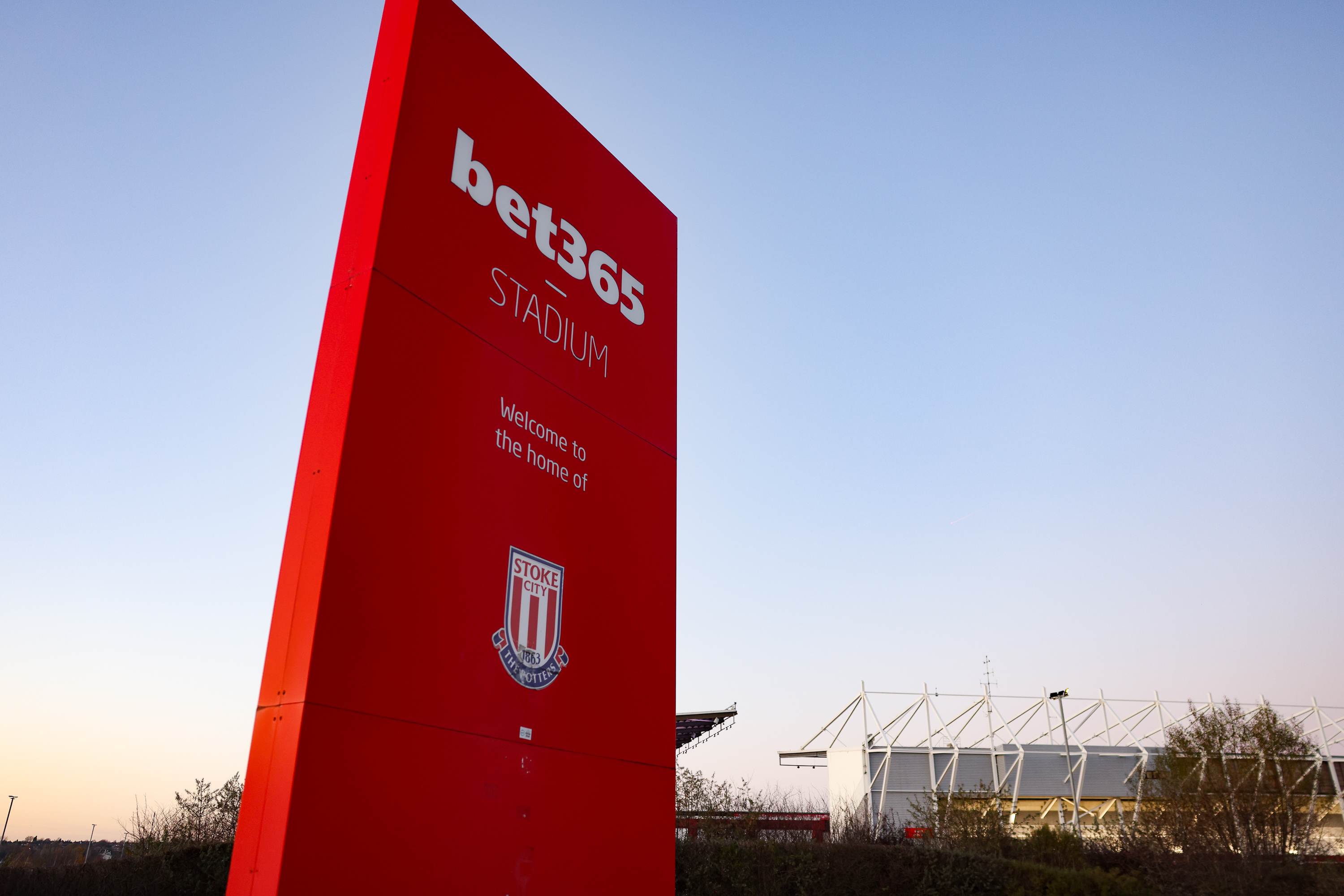 Bet 365 Stadium in Stoke–on–Trent, Andy Sumner/Focus Images Ltd/Sipa USA via Reuters Connect
The ethics of gambling funding health care, directly or otherwise, are knotty. At a time when the patchwork of access to palliative care is in the spotlight, it is problematic to say the least that there are parts of the country where hospice provision and a good death is reliant on the proceeds of others gambling away their livelihoods. There is virtue in philanthropy, to be sure, but at what cost? I am not convinced that the charitable contribution of the Coates family and other industry giants like them even begins to erase the human and economic costs and harms of gambling. Almost everyone in Stoke knows someone who has been treated at the cancer unit or the hospice, but almost everyone also knows someone whose life has been ruined on some level by gambling.
Ahead of the budget last autumn, when the government mooted increasing some forms of taxation on the gambling industry, a startling argument emerged in its defence. Far from being dens of iniquity, it went, betting shops are the new community hubs and their workers the new Samaritans. “Our betting shops are sanctuaries. I worry for the men if we close,” ran the headline of a Times article which lauded the contribution of the shops’ staff to the health and wellbeing of their customers. It painted the workers – overwhelmingly middle–aged women – as akin to social workers, with their shops being the only place many of their regulars could stay warm amid a cost–of–living crisis and soaring heating bills. It was an astonishing piece, and one I have found myself thinking about frequently ever since.
Admittedly, this is not an entirely new phenomenon. When my uncle, who ran a bookies’ shop on a less than salubrious Scottish high street, died a decade ago, the local newspaper announcement of his death read ‘late of’ followed by the name of the shop rather than the place he called home so that his regulars could come and pay their respects.
But if the argument that we owe betting shops a debt for their community contribution has any truth to it, then the hollowing out of the high street is far worse than even Andy Burnham fears. Recent polling from More in Common found that the public are more likely to say that they would prefer to see an empty shop front than a gambling shop on their high street. Not only is closing or limited betting shops likely to be popular therefore, but it suggests the public already recognise the flaw in the argument that such premises have community benefit. An empty shop, after all, contributes nothing to the economy or to the quality of life locally, but at least it does less harm.
There is a need, however, to go beyond this and build spaces that genuinely add to communities, rather than sucking the life out of them. For many of us, faith communities and their buildings naturally fulfil this role, and the Co-operative Party’s effort to revive the social clubs that were once the beating heart of communities also responds to the need for shared community spaces.
We cannot resign ourselves to a world where betting shops are the last bastions against the loneliness epidemic, and the gambling industry our strongest hope of regeneration in cities like Stoke. It is not just a crisis of local business or of micro–economic growth, but a crisis of community itself, and one of human dignity. Real regeneration means creating places of belonging that do not depend on people losing money in order for others to survive.
I would celebrate if high streets followed the front of football shirts in the list of places where gambling is no longer welcome, but I would celebrate even more if it was accompanied by the regeneration of the sort of community spaces, relationships and human connection that we are sorely in need of.
Interested in this? Share it on social media. Join our monthly e–newsletter to keep up to date with our latest research and events. And check out our Supporter Programme to find out how you can help our work.
]]>
Nick Spencer unpacks the relationship between environmental problems and democratic problems. 06/08/2026
Greetings. I write to you on day 5,379 of the Great Drought. We at Theos are surviving on the occasional eggcup full of stagnant rainwater, while we watch footage of southern England ablaze, and stare longingly at photographs of something The Elders tell us was once called “grass”. We hope you’re coping too.
A joke, of course, but not an especially funny one. As I write, half of England (and all of Wales) is in drought, having received about 3% of long–term average rainfall in July; the fire service is responding to 19 active wildfire incidents in the UK; huge tracts of France, Spain and Greece are burning; and the temperature is again predicted to hit the high thirties across most of central Europe this week. And then there’s also the rest of the world.
We can expect more to come. The young Bart Simpson once complained to Homer, “This is the worst day of my life”, to which his father sagely replied, “The worst day of your life so far.” Wags have memeified the exchange for climate change.
“We all know what to do,” the former Prime Minister of Luxembourg, Jean–Claude Juncker, is supposed to have remarked. “We just don’t know how to get re–elected after we’ve done it.” He was talking about economic reform and democracy, but if any arena owns this aphorism, it is climate change. We know what causes climate change. We know what we need to do to slow it (we can’t stop it now). But it is a super–wicked problem – combining all the classic problems of collective action, short–term cost vs long–term benefit, and extreme pathway dependency (the problem is essentially embedded in our daily lives). The environmental problem is, perhaps more so, a democratic problem.
Alas, we’re not exactly suffering from a surfeit of democratic trust at the moment. Theos research, to be published later this year, has found some eyebrow–raising results among the British population when it comes to the question of whether we need a “strong man” political leader who is “prepared to break the rules.” The virtues of pluralism, political patience, and democratic deliberation have seen their stock fall over recent decades.
But if the environmental crisis unfolds into a democratic one, the democratic one unfolds into a human one. Whatever ails our politics, its unlikely to be fixed by tweaks to the electoral machine, or even by the election of Count Binface in Clacton, epochal as that may prove. Democracy rests on pre–political foundations and, as Jonathan Sumption recently argued, “even the most carefully designed democracy can be subverted once the underlying spirit has gone.”
Over a decade ago, in his encyclical Laudato Si’, Pope Francis wrote:
“We urgently need a humanism capable of bringing together the different fields of knowledge, including economics, in the service of a more integral and integrating vision. Today, the analysis of environmental problems cannot be separated from the analysis of human, family, work–related and urban contexts, nor from how individuals relate to themselves, which leads in turn to how they relate to others and to the environment.” (#141)
He was spot on. The pressures of the hour call for (what he describes elsewhere in the encyclical as) “a genuine and profound humanism to serve as the basis of a noble and generous society”. (#181) Thankfully, there are signs of this emerging.
For a depressingly long time, many Christians were resistant to the green movement, because they saw it as pagan, and resistant to humanism, because they saw it as anti–religious (despite its deep Christian intellectual roots). As noted, Laudato Si’ ended the long drought of encyclical letters on environmental themes by rooting creation care in integral humanism. More recently, in 2020, Francis wrote in Fratelli tutti about “faith, and the humanism it inspires”, while just this year Pope Leo XIV’s much–lauded encyclical Magnifica humanitas pitted Christian humanism, against hubristic post– and transhumanism, insisting the while Christian humanism does “not reject science or technology, but embraces them with gratitude and realism”, it does so with the “higher vocation” of true human flourishing in its sights. (#129)
Earlier this year, a few members of the Theos team spoke at a conference, held at Washington National Cathedral and attended by over a thousand delegates, about Christian humanism and its potential to transform society. Later in the summer, Prof Luke Bretherton, who gave the keynote speech in Washington, assembled an academic conference in Oxford to discuss Reimagining Humanism. The historian of ideas Jens Zimmerman is about to publish a fascinating book on What is Christian humanism?
In other words, there is momentum here, as more and more people become aware of the way in which the current storms that are buffeting societies across the world are generated by deep weather patterns, originating miles away, in which the most fundamental questions that face human beings – who am I? who are we? to whom (and what) do we have a responsibility? and why? – are worked through.
As friends of Theos will know, this has been a theme in our work for many years now, linking theology (and, in particular, theological anthropology – the question of who I am, posed in the light of Christ) to everyday affairs. You can watch our most recent event on this topic, held at the National Gallery, in which Rowan Williams, Marcus du Sautoy, Ayla Lepine, Nathan Mladin, and Chine McDonald discuss “Art, creativity and what it means to be human in the age of AI” here. And you can also book to come to our next one, in September, on “Faith in Democracy”, in partnership with, and held at Westminster Abbey, here.
And as ever, there is a wealth of articles, longreads and reports on the Theos website, including our project uncovering the spiritual, social and political impact of motherhood (Motherhood, Inside Out), another of Emily Downe’s brilliant animations Making a Mother, and (sorry for the plug and even sorrier for the price; I didn’t make the decision) my forthcoming book that applies a Christian humanist lens to the question of future of welfare in the UK.
Happy August.
Interested in this? Share it on social media. Join our monthly e–newsletter to keep up to date with our latest research and events. And check out our Supporter Programme to find out how you can help our work.
]]>
Coco Parkinson–Huggins & George Lapshynov review Christopher Nolan’s ‘The Odyssey’. What if the stranger we should fear is ourselves? 04/08/2026
Why do stories written nearly three thousand years ago still captivate us today? Because the greatest stories are rarely about the past: they become mirrors in which every generation sees itself.
Few stories have proved more enduring in this respect than Homer’s Odyssey. Enter Christopher Nolan’s take on it, a blockbuster and star–studded screen adaptation of one of the most famous and influential stories in the Western cultural canon. It is perhaps unsurprising that Nolan decided to make his own version of the poem. As classicist Emily Wilson and others have argued, themes of journeying, homecoming, meaning and, indeed, a sense of man (and, in Nolan’s case, only ever of man) standing on the edge of world–historical change, are deeply Nolan–esque, from Interstellar to Dunkirk and Oppenheimer.
These are themes of Nolan’s work for a reason; they speak deeply to our contemporary moment. Whether it is the nonchalance with which tech giants affirm that AI may well destroy humanity, what appears to be the ever–deepening polarisation of politics, or the increasing frequency of climate change–related disasters, there is a strong sense that we are collectively on the edge.
That atmosphere permeates Nolan’s Odyssey. Hanging throughout the film is a sense of impending crisis. Within the story’s historical context, this takes the form of the Bronze Age Collapse. Within our contemporary context, to which the story alludes, it refers to notions of a collapse of the West (whether perceived or actual). Characters whisper about the approaching “people from the sea”, mysterious outsiders who will bring about the end of their civilisation. The mood is unmistakably eschatological, and it is difficult not to hear in it echoes of the End Times, including the biblical language of judgement and endings.
What struck us most, however, was what this impending coming of “the people from the sea” was accompanied by: the breakdown of “Zeus’s law”. Whilst questions of travel, migration and the encounters with strangers are certainly strong themes in Homer’s original, Nolan arguably makes xenía, the sacred duties between host and guest, far more explicitly the moral axis of the story. Indeed, Nolan’s depiction of Zeus’s law bears a striking resemblance to biblical ideas of hospitality, as Krish Kandiah and others have pointed out. If the Odyssey has shaped the minds of most Western writers for centuries, then so have biblical stories which repeatedly present the stranger as a figure through whom God (Genesis 18, Matthew 25) and his angels (Hebrews 13) may be encountered.
Across Nolan’s film, there is a persistent sense that this moral order is fraying. In much the same way, contemporary political language across both the Left and the Right in Britain is filled with anxiety about the erosion of the moral assumptions on which our common life depends. Whether expressed through concerns about the “rules–based international order” governing global cooperation, the decline of trust in public institutions, or the loss of a shared national cultural inheritance, depending on one’s priorities, there is a seemingly universal sense that something which once held society together is becoming harder to sustain. Can a society survive when trust and hospitality cease to be? The Odyssey offers an imperfect (and somewhat gratuitously violent) but compelling parable of what happens when our common life is no longer rooted in shared moral commitments.
In this context, the Trojan horse is not only a brilliant military trick; it is portrayed as a sacrilege against hospitality, an attack on what holds society together. It becomes, argues Joseph Earp, the moment when trust breaks down, when a horse is no longer simply a horse and appearances can no longer be believed. Not simply the lies we tell, but the institutions, technologies and political projects that promise security or prosperity while quietly corroding the trust on which societies rest.
The irony is that through its shallowing and blockbuster–ing of much of its characters, the film undercuts the very themes it wishes to explore. The female characters from Penelope through to Calypso are all but hollowed out. Even the choice to parachute some of Hollywood’s biggest names into leading roles distracts from the serious themes it wishes to discuss. Meanwhile, the film’s breathtaking photography and the scale of the production overwhelm the human stories of suffering it intends to honour.
Just as he does not realise that it is his own acts of destruction on this journey home that are contributing to its tearing it apart, the film calls us to reflect – in a somewhat heavy–handed way – on how the forces eroding our own common life are not only beyond our borders but also within our own habits, institutions, and actions. Every civilisation fears the stranger. Nolan asks a more uncomfortable question: what if the stranger we should fear is ourselves?
Perhaps that is why The Odyssey still matters. It reminds us that every civilisation eventually faces the same question: not simply whether it can defend itself, but whether it still remembers the moral vision that made it worth defending.
Nolan’s film cannot fully answer that question. It remains, ultimately, a Greek tragedy in which violence restores order only temporarily. Christianity offers a different ending, one in which homecoming comes not through vengeance but through grace.
Even so, Nolan leaves us with an important warning. The forces capable of unravelling a civilisation are not always waiting beyond our borders. More often, they begin within us, whenever trust gives way to suspicion, hospitality to fear, and our shared moral imagination begins to fade. The question is, what are our Trojan horses?
Interested in this? Share it on social media. Join our monthly e–newsletter to keep up to date with our latest research and events. And check out our Supporter Programme to find out how you can help our work.
]]>
Esmé Partridge shares the stories of young Christian converts from new report with the Church of England. 27/07/2026
To grow up in the world today – to grow up online – is to experience culture as a dizzying kaleidoscope of images and ideologies. The beliefs and values held by young people are rarely ones they have inherited, but rather chosen from the vast array of options in a postmodern, digital age: wellness culture, alternative spirituality, “manifestation”, self–optimisation, therapy TikTok, financial gurus, the manosphere.
Yet a curious feature of this strange new world is that it can also throw up ancient ideas and timeless truths in places where they are least expected. In a climate where anything goes, beliefs previously thought outdated or irrelevant may find new expressions and new legitimacy. Even Christianity may become a viable option once again, even if it is only one of many possibilities for spiritual exploration. In this sense the digital world may be seen as the culmination of what sociologist Zygmunt Bauman called ‘liquid modernity’, in which all socially dominant narratives – including secularism itself – have melted away.
This was the experience of many of the young adults Theos interviewed for its new report on young adult journeys to church, who have found faith in what might seem like unlikely and surprising circumstances. The report, published last week by the Church of England, brings together the stories of thirty 18–30 year olds who have found a spiritual home in Anglicanism. Most of these journeys were long and winding. They did not come about because the Church of England was the default option or something they were familiar with from their upbringing. Instead, having grown up in mostly secular or other religious families, they came through their own personal explorations, most beginning online and out of the postmodern supernova of belief. Sometimes slowly, sometimes suddenly, they became open to the idea of Christianity – often having previously held very different views.
Some of these young people had previously been militant atheists, describing having a “teenage atheist phase” before later coming to faith. Farid*, a medical student in his early twenties from a Muslim family, developed strong opinions against religion having spent his early teens on the Reddit forum R/atheism and watching YouTube videos from the likes of Richard Dawkins and Alex O’Connor. “These guys hard launched my atheism in my teens”, he explained. Other men had said they had been enticed by right–wing manosphere influencers and the ideas of self–improvement they promoted. One 18 year old described how he got into bodybuilding, believing that “if you just get muscly, you’ll be happy”.
Others, particularly among the women interviewed, said they had previously dabbled in alternative spirituality. Many commented on the popularity of astrology and manifestation on social media, especially during the Covid pandemic. Abby*, a 24 year old nurse from the East Midlands, described how through encountering New Age spirituality and tarot cards on Instagram, she put her trust in “the universe” rather than God because “that was just what was accessible to me at that time”. She explained that her generation were drawn to these spiritualities because they were searching for some meaning or guiding purpose in life, making them open to just about anything. Among Gen–Z, one 19 year old convert said, “there’s just a longing for truth”.
There were others who pursued this longing for truth in religions like Buddhism and Hinduism. Whilst at university, Dom*, a 24 year old from Surrey, stayed up all night listening to talks by the Eastern religious philosopher Alan Watts. Others had been interested in Islam, which another young man said “opened up my mind to what God was as an idea” years before he considered Christianity.
It was sometimes through these other ideas that people, accidentally or otherwise, eventually found Christianity. Marina*, a 25 year old who works in a nursery, had followed alternative spirituality. But one day, a spiritual influencer she had been following on Instagram posted a Christian testimony out of the blue. Seeing her renounce her previous occult beliefs, Marina said, “sparked my curiosity but also scared me…I just never really considered that they were opposing [spiritual] forces”. This revelation led Marina to buy a Bible. In reading it she found deep solace and felt called to explore further, eventually deciding to attend a church near her.
There were others who stumbled across Christian content randomly – or perhaps providentially. Becky*, a young mum from the South West who grew up with an atheist mother and satanist sister, described how one day her phone “started showing me loads of TikToks and Facebook posts, all to do with Christianity”. She thought “OK, I’ll watch a few.” But realising that she “found so much peace and joy” in watching the videos, she kept clicking, “end[ing] up down this rabbit hole of sermons and speeches”. In retrospect, Becky says, this content suddenly appearing on her feed can only be explained by providence; what she described as “the Holy Spirit moving through the algorithm”.
Similar stories included Jake*, a 22 year old aspiring entrepreneur, who only became curious about faith after watching livestreamers on the gaming platform Twitch who mentioned being Christian. For Carmen*, a gap year student in the Midlands, it was seeing an artist she followed on Instagram post paintings inspired by Bible stories that inspired her to go deeper into Christianity, turning what had initially been a purely intellectual curiosity into a personal one.
The result for many people was a period of deep exploration that went beyond short–form online content and into longer podcasts, articles and books. These young people, whether or not they had been to university, were remarkably autodidactic. They spent hours watching theological YouTube channels like “Pints with Aquinas”, studying contemporary theologians like David Bentley Hart, and even reading Christian novelists like Dostoyevsky. These explorations carried them a long way on their spiritual journey, with many seriously considering becoming Christian at this stage.
However, strikingly, these explorations alone did not tend to convert them. Despite first discovering faith in a highly postmodern, virtual way, the deeper spiritual shifts that people described almost always occurred through a personal relationship or real–life encounter. For example, Owen*, a 28 year old from Yorkshire, had been researching the religious beliefs of J.R.R. Tolkien, being a lifelong fan of The Hobbit (with a Lord of the Rings sleeve tattoo to prove it). But it was only after passing his local parish priest in the street one day and getting to know him that he seriously thought about becoming a Christian himself. He described spending hours talking to the vicar, who offered personal guidance and answered his many questions. It was through this relationship that Owen’s curiosity grew into church attendance and, eventually, baptism.
Similarly, Jamilah*, a postgraduate medical student, had also been thinking about Christianity independently, but only made the decision to go to church after forming a close relationship with a pastoral support officer at her university. From housemates and partners to teachers and childminders, almost every story involved some individual who played a decisive role in the journey to church, providing a living example of faith, hope and joy.
Others were transformed by emotional and spiritual encounters they had upon entering a church for the first time. For Dylan*, a recent English graduate, it was stepping into a medieval parish church and seeing rainbow light beaming through the stained glass windows that first awakened his sense of the numinous. “I thought it was the most beautiful thing I’d ever seen”, he said. “I didn’t quite know what to do with the feeling…so I kept going back to that church”. At his first service there, he went up to the altar and described feeling an “overwhelming love” while receiving a blessing. He now goes to that church every Sunday, sings in the choir, and was recently baptised there.
Another student who came to church through her university’s Christian Union described going along to a service for the first time and being suddenly and unexpectedly moved by its “atmosphere of safety, people being so vulnerable…but so joyful…it was just an environment that I had never experienced before.” For her and others, it was these real–life spiritual encounters – of kindness, goodness, beauty and truth – that brought them into the Church.
What might these findings tell us about young adult journeys to faith today, in the Church of England and beyond? It is certainly true that the channels through which people discover Christianity in a digital age are novel and unpredictable. And yet, what is striking about these stories is that what really moved people – what turned them to Christ – were real relationships, real places, and real experiences. It was encountering the beauty of a sacred space; receiving a warm welcome from a congregation; spending hours talking with clergy and being able to ask them questions. The spark of curiosity may come from somewhere new, but the factors that sustain faith are unchanging – they are rooted, relational and timeless.
*All names were changed for the purposes of this research.
You can read The Church of England report ‘Understanding young adult journeys to faith’ here.
Interested in this? Share it on social media. Join our monthly e–newsletter to keep up to date with our latest research and events. And check out our Supporter Programme to find out how you can help our work.
]]>
Chine McDonald reflects on the life and legacy of Broadcaster and Journalist, Edward Stourton. 21/07/2026
It was rare for broadcaster Edward Stourton’s name to appear without being prefaced by the word ‘veteran’. His style steady, his voice instantly recognisable, Stourton represented the best of British broadcasting and, in particular for us, a British broadcasting that took religion seriously. This week, he died at the age of 68, and tributes have been pouring in.
Born in Nigeria in 1957, Stourton was educated at Ampleforth College before going up to Trinity College, Cambridge, to read English Literature. His career started as a trainee at ITN and then a founder member of the Channel 4 News team before becoming a stalwart of the BBC, where he spent most of his career, presenting Radio 4’s Today programme for a decade until 2008, as well as The World at One and The World This Weekend. Current Today editor Rebecca Keating said she and her colleagues described Stourton as the “Rolls Royce of broadcasting”.
That someone of Stourton’s journalistic stature devoted so much of his career to religious affairs, most notably as a long–time presenter of Radio 4’s Sunday, was significant. When religion can so often be treated as either irrelevant or a culture–war battleground, he approached faith with the seriousness it deserved. He neither sensationalised nor trivialised it; he simply believed it was important enough to understand well.
It was on Sunday that several of the Theos team regularly encountered Stourton. To be interviewed by him was both terrifying (he was the Edward Stourton, after all), but also strangely reassuring. This was a man who knew his stuff when it came to religion. You knew he would have done the reading, that he understood the theological nuances, and that he was more interested in getting to the truth of a matter rather than point–scoring or hearing the sound of his own voice.
He was particularly knowledgeable about the Catholic faith, which played a significant part in his personal life. In a Christmas edition of BBC One’s Mastermind, chaired by his Today co–presenter John Humphrys, his chosen subject was Pope John Paul II. He later wrote a biography of the former pope – John Paul II: Man of History – one of several he wrote about the Christian faith, which also included In the Footsteps of St Paul.
It was his 2023 book Sunday: A History of Religious Affairs through 50 Years of Conversations & Controversies for which Theos hosted a book launch, in partnership with Sandford St Martin Trust and the book’s publishers SPCK. There, I had the honour of interviewing Stourton and his co–author and long–time Sunday producer Amanda Hancox, about the biggest religious affairs news stories over the past five decades.
It was after Stourton disclosed in his memoir Confessions: Life Re–examined that he was living with incurable prostate cancer that we invited him to write the foreword to our report Ashes to Ashes: Beliefs, Trends and Practices in Dying, Death and the Afterlife.It explored how Britain is rethinking death, dying and the afterlife in an increasingly secular age, and how the role of faith communities within the death process is changing, too.
Stourton wrote in the foreword: “Religion – and I am sure this applies just as fully to the United Kingdom’s minority faiths as it does to Christianity – still seems to be a source of strength we turn to when confronted with the enormous enigma of death…“As someone with a slow–moving but incurable cancer, I welcome the greater openness about death this report identifies. It is certainly true, as the report finds, that many people are turning to new and more secular ways of celebrating the memory of those they loved, but most religious traditions can call on the experience of centuries of responding to the reality of death, and they have much to offer in a debate of the kind Ashes to Ashes seeks to encourage.”
Reading these words now is both poignant and insightful into who Stourton was. He wasn’t someone interested in easy answers or saccharine optimism. Rather, he understood that religious traditions carry a depth of wisdom which remains relevant, even (or especially) in a society that often imagines it has moved beyond them.
Edward Stourton was a friend of Theos, once describing it as “an inspired idea” that filled “a big gap in our culture”. But for us, his greatest legacy was in showing that journalism about religion can be both rigorous and generous; that broadcasters can combine scepticism with respect; and that faith, when treated with intellectual curiosity and seriousness, belongs not at the margins of public life but at its heart, offering answers to some of the biggest challenges our society faces today.
Interested in this? Share it on social media. Join our monthly e–newsletter to keep up to date with our latest research and events. And check out our Supporter Programme to find out how you can help our work.
]]>
Catch the thought–provoking conversation taken from the panel discussion at the our event ‘Making a Mother’.
In April, more than 150 women attended our event at St Giles Church, Camberwell to explore a question that’s both deeply personal and publicly important: what makes a mother?
This conversation is taken from the panel discussion at the Theos event ‘Making a Mother’, which took place on April 29 2026. We heard from Theo Clarke MP, Lucy Jones, Chine McDonald, Rev Alice Watson, and Dr Madeleine Pennington.
Our conversations reminded us that while many mother share common experiences, no journey through pregnancy, birth or motherhood is ever the same. Every story is unique, and every story matters.
We’re also looking ahead to our new report, ‘Motherhood, Inside Out’, which will explore those lived experiences in greater depth, from physical realities of motherhood to the emotional, relational and spiritual changes that often accompany it.
Find more of our work on motherhood and sign up to be the first to hear about future releases here: https://www.theosthinktank.co.uk/motherhood
Recorded by Joshua Lelo.
Interested in this? Share it on social media. Join our monthly e–newsletter to keep up to date with our latest research and events. And check out our Supporter Programme to find out how you can help our work.
]]>
Chine McDonald unpacks the state of theology and religious education in the UK. TRS is more than just a ‘soft’ conversation 09/07/2026
There may be trouble ahead in the world of religious education. While steps are being made to strengthen RE within schools, theology & religious studies (TRS) departments at universities are quietly disappearing. Over the last 20 years, the number of TRS departments in England and Wales has roughly halved. While the schools sector is recognising the need to bolster faith literacy and education among pupils, the future pipeline of those equipped with skills to teach the school pupils of tomorrow well is being decimated.
Added to this, the decline in TRS, social sciences and humanities departments more generally across the UK are coming at a time when we need people equipped with the skills of philosophical, spiritual and ethical enquiry to wrestle with some of the big questions we are asking today: what does it mean to be human? What is the impact of AI on our understanding of who we are? What is a good life? How do we live well together?
Last weekend, Secretary of State for Education Bridget Phillipson announced that proposals to make religious education part of the English national curriculum, having received a consensus of support from the RE sector, would move to the next steps with a public consultation in the autumn. While RE is compulsory in schools in England, it does not currently form part of the national curriculum, leading to significant variation in the content and ways of teaching the subject at school level. The government had last year accepted a call for inclusion within the national curriculum, provided that the RE sector could reach consensus on what religious education in the national curriculum should look like.
With consensus now reached – and ahead of Phillipson potentially being reshuffled out of her position at the Department of Education (DfE) when Andy Burnham becomes prime minister – plans will now begin on the how and what of RE’s integration into the new national curriculum.
“Learning about the world’s great faiths and traditions teaches children not just about the world, but how to live alongside and tolerate one another within it,” the Secretary of State said. “In such fractured times, it should be a source of hope that those representing the full spectrum of religion in this country have reached consensus on the most fundamental of points: what our children should learn about the world’s faiths, communities and traditions.”
This milestone is to be celebrated – it could have so easily been a different story, of no consensus. Tireless work by many across the sector, including our friends at Culham St Gabriel Trust, has led to this historic move towards strengthening teaching of religious education in schools. But who will teach it? And how can religious education wherever it is found – in schools, lecture theatres, and beyond the classroom (see our 2025 report on this) – be seen as not just a nice to have, but a necessity in these fractured times?
Sometimes a defence of TRS can fall into the trap of sounding… well, soft. We speak of understanding and tolerance, of being able to see another person’s point of view. But – good though these things are – it’s about more than this.
Last month, I was at the DfE for the first meeting of its Community Cohesion Advisory Group. Run by DfE in collaboration with the University of Salford and the National Union of Students, the group has been brought together to provide feedback on a research–based approach to developing a cohesion framework for education. There, Minister of State for Skills, Baroness Jacqui Smith, spoke of the important role higher education institutions in fostering a sense of communality and cohesion, as well as tackling misinformation.
This is not just fluffy stuff. Sometimes it’s a question of life and death. Nic Beech, vice–chancellor of the University of Salford, said that we are living in a “period of heightened polarisation” and pointed to the attacks in Heaton Park, Golders Green, Belfast and Edinburgh as examples. “There is an urgent need to come together,” he said.
In this setting, I highlighted the importance of religious education and literacy as something we just cannot ignore. Many of the atrocities we see stem from religious and ethical ideologies. Organisations like ours are among the few in the nation who are equipped try to make sense of them.
It’s why TRS is more important than ever. It’s great that the schools sector is starting to understand this, but the closure of religious education departments across the country suggests higher education institutions don’t.
We’ve long seen this coming. Last year, we penned this open letter, signed by people from across different spheres in public life – some of whom are TRS graduates – calling for the safeguarding of religious education. But it seems very few in higher education are listening. For many university vice–chancellors, theology and religious studies, social sciences and humanities, make little business sense. For prospective students facing extortionate tuition fees, the pressure to study a subject that offers the strongest chance of a job with a high salary (which, dare I say it, aren’t the ones that are instinctively geared towards working for the common good) is strong. It’s a sad state of affairs when everything becomes about financial gain.
TRS provision is patchy and dwindling at a time when we need it more than ever. As my colleague George Lapshynov writes so eloquently in our latest Theos blog: “Critical religious literacy, the ability to understand, interpret and engage with different beliefs, is unevenly distributed. Where it is weak, empathy and cohesion suffer, and misunderstanding grows.”
Interested in this? Share it on social media. Join our monthly e–newsletter to keep up to date with our latest research and events. And check out our Supporter Programme to find out how you can help our work.
]]>
George Lapshynov responds to the University of Exeter’s considerations to cut Humanities staff and calls for safeguards to religious education.
Nearly a year on from Theos’s open letter calling for urgent action to safeguard Theology and Religious Studies (TRS) in higher education, news last week that the University of Exeter is considering significant staff cuts – affecting disproportionately the Humanities, Arts, and Social Sciences – reminds us that the situation has not stabilised. If anything, it has gotten much worse.
Among those affected, and calling for TRS (and her and her colleagues’ jobs) to be saved, is Professor Francesca Stavrakopoulou, a prominent public intellectual and leading scholar of religion.
Disciplines like theology, religious studies and philosophy are precisely the disciplines that help us understand meaning, belief, culture and human difference. They gave us Renaissance Humanism, the Enlightenment, and the intellectual foundations of human rights and liberal democracy. The fact that another Russell Group university is now considering shedding them should alarm us. It is a sign we are losing, or perhaps choosing to ditch, our collective capacity to understand belief and worldviews critically and rigorously.
Exeter is not an isolated case; this moment has been a long time in the making. TRS in UK higher education has been in sustained decline for over a decade. Student numbers have fallen sharply since the early 2010s, driven partly by high tuition fees and a narrow ‘value for money’ logic. Departments have merged, fragmented, and closed; centres of expertise have been dispersed or lost. Two decades ago, there were more than forty TRS providers. Today, that number has roughly halved. An entire academic community is hollowing out.
But why should we care?
It might be tempting to see TRS as a niche, confessional subject, attractive only to the dwindling number of practising religious Britons, dispensable when difficult financial choices must be made.
Thinking this way would be a profound mistake.
First, the loss of TRS impoverishes the university itself. The study of religion is embedded across the humanities and social sciences, offering distinctive historical, sociological and philosophical approaches to understanding texts, cultures and human behaviour. Well beyond the mere promotion of belief, TRS gives us the tools to look critically, historically, and comparatively at some of the most fundamental and ancestral aspects of human life. This is only made evident by the fact that some of the most prominent scholars in the field – such as Professor Stavrakopoulou herself – are very openly atheist. Additionally, students in TRS mingle with students in other disciplines and cross–pollinate. Debates from different disciplines bleed into each other. Remove it, and the university’s intellectual ecology, including its other humanities and social science subjects, is diminished.
Second, this erosion reflects a wider fragility in the humanities. In an era dominated by STEM and business, these disciplines are often dismissed as less valuable. This is ironic as it is precisely scientific discoveries and rapid technological change, such as artificial intelligence, that are forcing us to confront now more than perhaps ever before questions about meaning, agency and responsibility. TRS and the humanities are essential to the intellectual infrastructure we need to ensure that technology serves human ends, rather than the other way round.
Humanities graduates remain also highly adaptable, bringing communication, creativity, and analytical skills that employers actively seek. UK humanities research is globally leading and disproportionately impactful. To weaken it is to undermine one of the country’s genuine strengths and sources of soft power, and our ability to contribute to world culture.
But the most serious consequences lie, arguably, beyond the university.
We live in a world shaped (often decisively) by religion and belief. From geopolitics to local communities, from healthcare to education, questions of faith and worldview are ever–present. Yet, as Theos’s Beyond the Classroom report highlights, our collective ability to navigate these realities is uneven. Critical religious literacy, the ability to understand, interpret and engage with different beliefs, is unevenly distributed. Where it is weak, empathy and cohesion suffer, and misunderstanding grows.
TRS provision helps directly address this. It forms not only more religiously literate citizens but also the specialist RE teachers who shape the next generation. The shortage of well–qualified RE teachers, closely linked to weakening TRS provision, is already a recognised challenge, and will get only worse.
What is perhaps most striking is that all this is happening just as the need for religious literacy is increasing. Government policy increasingly emphasises “faith and belief literacy” for social cohesion and national resilience. Public services are encountering growing religious diversity and recognise the need for better training. Globally, religion continues to shape political and social realities in ways early–2000 ‘end of history’ supporters could not have conceived.
In other words, just as demand for expertise grows, we are dismantling the structures that produce it.
The loss of TRS capacity would therefore be catastrophic, not only for the discipline but for the wider ecosystem of education and public life. Universities lose intellectual depth. Schools lose a pipeline of specialists, even as RE looks set to gain status in the National Curriculum. Public services lose access to essential expertise. Above all, society becomes less able to understand itself.
Nearly a year ago, Theos and many others called for urgent action. That call remains unanswered. Policymakers, universities, and civil society must recognise what is at stake and act together. Financial pressures in higher education are real – there is no denying it. But if we allow them to quietly dismantle the very disciplines that help us understand ourselves and one another, we will pay a far higher price.
The questions Exeter and other institutions are answering for us – whether or not they are aware of it – are about the kind of society we want to be, about deciding whether we still value the knowledge needed to live together well in a diverse, complex world. If we do, we cannot afford to let Theology and Religious Studies, and the wider humanities, wither.
If we wait until the last TRS department closes up shop to act, it will be too late.
Image credit: Photo by Álvaro Bernal on Unsplash
Interested in this? A more detailed resource on the importance of TRS will be available this August. You can also watch Francesca Stavrakopoulou’s interview on The Sacred podcast here.
Subscribe to our newsletter to stay up to date with our latest work.
Nick Spencer speaks with historian and journalist Bijan Omrani. 23/06/2026
The idea that our country is Christian – in the historical sense of having been comprehensively formed by the faith – is sometimes taken as a kind of Christian nationalist dog whistle. But it shouldn’t be.
In reality, this is true for most countries in Europe, in which, in spite of massive secularisation in the later 20th century, Christianity’s fingerprints are everywhere.
So, what is England? How has the English nation, its laws, politics, culture and literature, been formed by Christianity? And (how) can they survive without it?
This week on Reading Our Times, Nick Spencer is joined by British historian and journalist Bijan Omrani to discuss these questions and more, delving into his new book, provocatively titled God is an Englishman: Christianity and the Creation of England.
You can purchase a copy of his book here.
Listen to the episode on Apple Podcasts here.
Interested in this? Share it on social media. Join our monthly e–newsletter to keep up to date with our latest research and events. And check out our Supporter Programme to find out how you can help our work.
]]>
Nick Spencer explores what people across the UK believe is important when they think about British identity. 19/06/2026
Summary
Ten years ago, the UK voted to leave the European Union. The referendum drew on and then intensified the debate about what it meant to be British, a debate that has, if anything, deepened over recent years, as concerns around immigration, asylum, the rise of Islam, the rise of China, and the alleged decline of Europe and the West have come to dominate the news cycle.
As part of Theos’ work exploring the rise of Christian nationalism in the UK and Europe, this essay explores perceptions of Britishness, among people living in the UK, today.[1] We commissioned research into the relationship between nation and religion from RED C, technical details of which can be read here.
We found that the more lurid concerns about the UK sliding into exclusive forms of “ethnonationalism” have not been born out.
Britain remains strongly characterised by forms of civic, cultural and emotional belonging, with Britons leaning heavily towards achieved (and inclusive) identity when it comes to being “truly” British.
Based on new research commissioned by Theos and conducted by RED C, four factors are especially important to the UK population when it comes to their perception of what makes one truly Britishness, namely (in descending order):
– obeying the law
– being committed to democracy and freedom of speech
– speaking English
– contributing economically
More recent anxieties about the UK being gripped by Christian nationalism are also overblown. Levels of belief that you need to be Christian in order to be British are low compared to other Britishness factors, as low as those that say you need to be white to be British.
However, there are some causes for reflection and perhaps concern.
While “respecting the authority of parliament”, one of the pillars of political/ civic identity, is widely considered to be important for Britishness, it is very rarely considered the most important factor. This is noteworthy given how central parliament is to our political/civic identity. This presumably reflects widespread political disaffection at the moment, which, if left unchecked, could threaten to erode that commitment to political/ civic identity more generally.
Conversely, while ethno–nationalistic identity is rarely considered important, the importance of natal identity is thought somewhat higher (45% agree that being born in Britain is important for being truly British) and is judged to be the most important factor by nearly a third of those people. In other words, many of those who are inclined towards natal identity as a characteristic of Britishness, are strongly inclined that way.
Those who have an ethnic/ natal or a political/ civic idea of Britishness are intensely exercised by a handful of (different) issues each.
– The ethnic/ natal group are particularly focused on the level of immigration, the number of Muslims, and the number of asylum seekers but also, notably, the cost of living today, and the issue of national ID cards.
– The political/ civic group are particularly anxious about the level of racism, climate change, the rise of the far right, and the anti–vaxx movement.
– By comparison those who have primarily a cultural or emotional conception of Britishness are less intensely exercised by these (or indeed) issues.
Contents
1. Summary
2. Contents
3. Introduction
a. Seven dimensions of national identity
b. Conducting research
4. What does it mean to be British? An overview
5. What’s the most important factor in being British?
6. What issues preoccupy different ideas of Britishness?
7. Conclusion
Introduction
Seven dimensions of national identity
There are different ways in which people in a country can feel and express their national identity and loyalty.[2] The most familiar is the distinction between ‘civic’ and ‘ethnic’ national identity, the former focusing on commitment to political institutions, the latter on birth and ancestry. The divide runs deep. It maps onto debates about whether countries are, on the one hand, created or “imagined”, or, on the other, natural and inherent. It also maps onto contemporary concerns about the nature and possibility of social cohesion, with ‘civic’ identity considered more “achieved” and therefore inclusive, while “ethnic” identity is more “ascribed” and therefore exclusive.
While this distinction is foundational, it is also incomplete or at least inexact. There are various factors, not least cultural ones, that can blur the boundaries of the civic and the ethnic. Celebrating national customs and traditions, for example, are, in theory, civic identity markers, open to everyone. But because such customs and traditions are often deep–rooted and historically embedded, they are not necessarily easily or quickly “achieved” and can feel more ascribed. The ex–pat Briton who moves to Japan is unlikely to become a connoisseur of the quintessentially Japanese tea ceremony in quick time.
For that reason, it can be helpful to disambiguate the drivers and sources of national identity beyond the ‘civic/ethnic’ divide. In our research, we picked out seven different dimensions of national identity.
1. Political/ civic identity. To be British, means to have a commitment to certain political/ legal/ constitutional arrangements and institution.
2. Ethnic/ natal identity. To be British, means having been born here or being white.
3. Cultural identity. To be British, means participating in and celebrating British customs and traditions.
4. Religious identity. To be British means having a commitment to the historically dominant religious tradition of the country, meaning Christianity.
To these four (and relatively familiar) factors, we have added three others, which are often overlooked but play a serious role in debates around national loyalty.
5. Geographic identity. This is a relatively thin form of belonging, entailing nothing more than simply inhabiting the country. Nonetheless, it is important to include as 5.5 million (or 8 per cent) of British citizens live abroad, something often overlooked in debates around Britishness
6. Economic identity. Very often, the immigration debate is framed not so much around how many immigrants come here but what they do when they are here and, in particular, whether they contribute economically. Public opinion is, not surprisingly, rather different according to perceptions of whether they do.
7. Emotional identity. Finally, simply the way that people feel about their country is vitally important, and an important subjective factor to place alongside the other (slightly) more objective ones.
Conducting Research
In order to measure these different forms of national identity, we asked people how far they agreed or disagreed with a series of 12 statements about being British, that covered the seven different dimensions outlined above.[3] These were, “To be truly British you should…
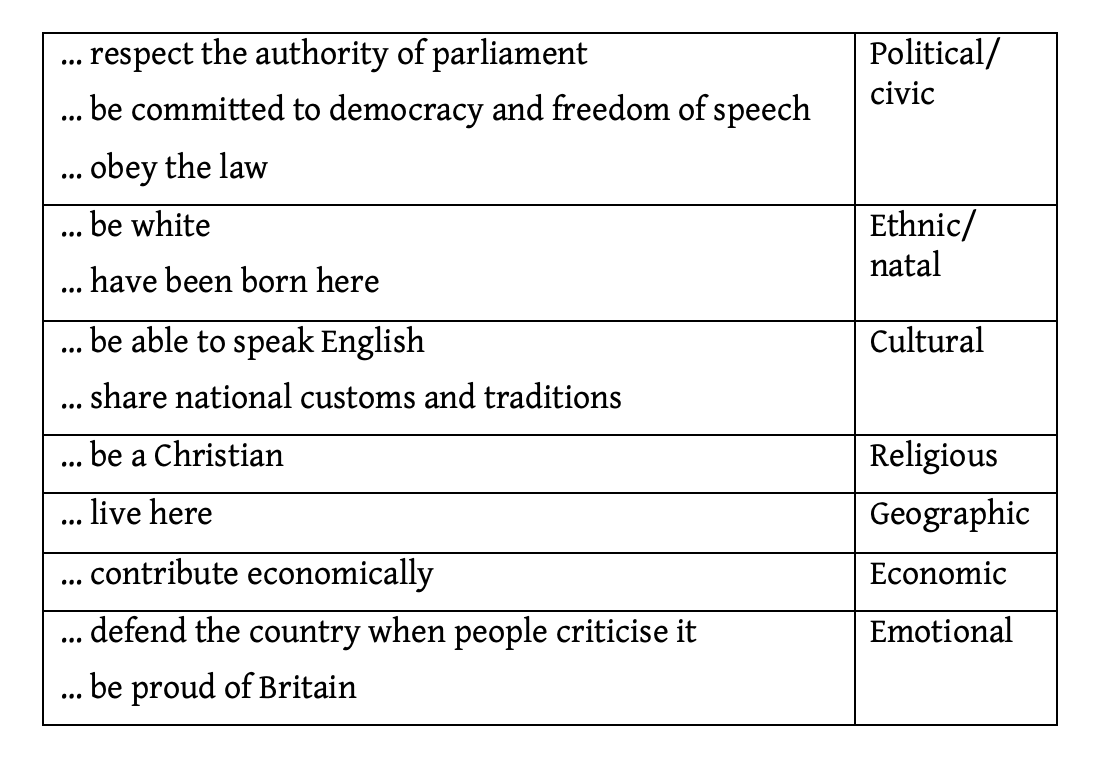
In the first instance, respondents were asked whether they agreed (on a five–point scale from strongly agree to strongly disagree) with each statement. In the second, respondents were asked to select the single “most important” factor that defined Britishness.
What does it mean to be British? An overview
The first pass at this question generated the following results.
Figure 1: To be truly British you should… (levels of agreement)
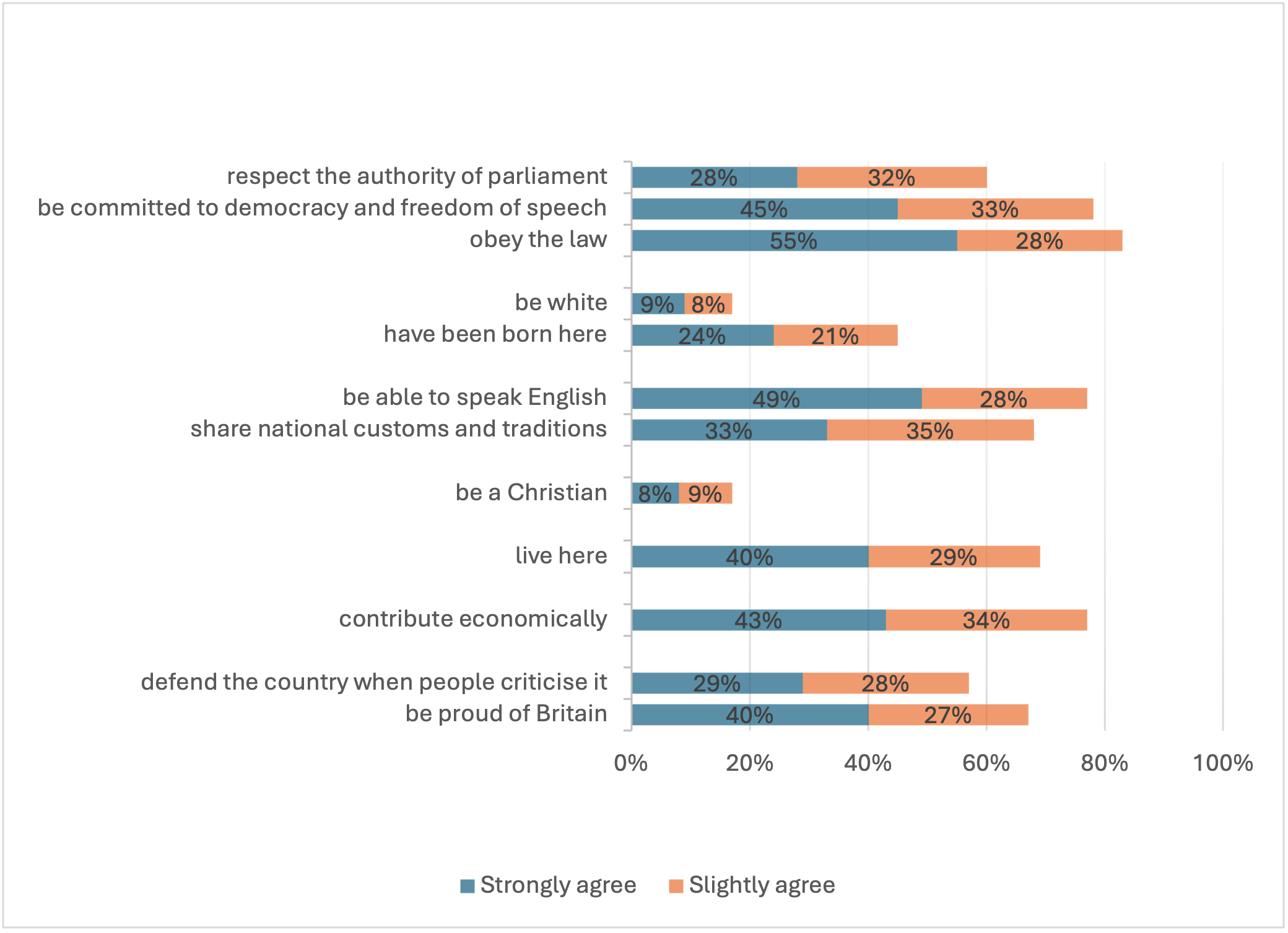
The first observation to note here is that there are clearly two separate categories of identity when it comes to public opinion. Political/ civic, cultural, geographic, economic, and emotional conceptions of identity are all relatively high, getting 60–80% agreement by UK adults, whereas ethnic/ natal and religious forms of identity are seen as comparatively less important. The only mid–way exception is the ethnic (specifically natal) form of identity (having been born here), which 45% of people agree is important to be “truly” British.
Of the more widely recognised dimensions of identity, political/ civic is seen as most important with 83% of people agreeing that to be British you need to obey the law, and 77% that Britishness requires being committed to democracy and freedom of speech.[4] The only (slightly) weaker element in this category was “respect[ing] the authority of parliament”, with only 60% agreeing, arguably reflecting current widespread political disaffection.
Cultural and economic identities are also seen as significant, with 77% of people agreeing that speaking English is an important dimension of Britishness, 68% “sharing national customs and traditions” and 77% saying that contributing economically was important to being truly British.
Religious and ethnic identity on the other hand, were only deemed important to being truly British by a minority, just 17% of people in each case.
Overall, therefore, it is clear that Britons lean heavily towards achieved (and inclusive) identity and loyalty when it comes to being “truly” British.
Further clarity can be acquired on this issue when we factor in not only levels of agreement but also the level (and strength) of disagreement on these issues. For example, it is salient that nearly half of all people strongly disagree that you need to be white to be truly British. By applying a rating score to people’s views on this issue,[5] we can evaluate overall balance of public opinion.
Figure 2: To be truly British you should… (balance of public opinion)
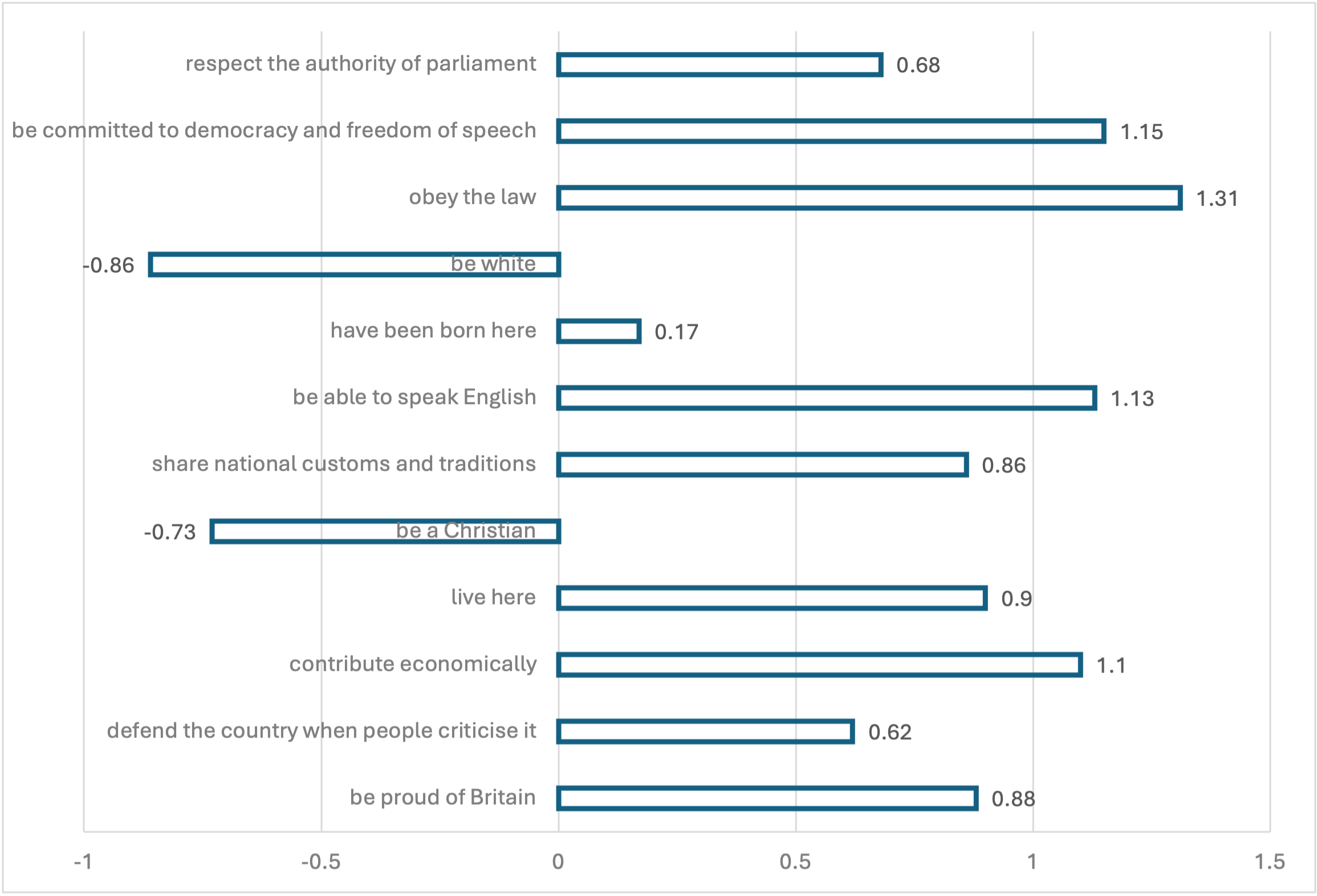
This calculation shows that four factors – one economic, one cultural, and two political/ civic – are particularly important to the UK population when it comes to their perception of what makes one truly Britishness, namely:
– contributing economically (1.1)
– speaking English (1.13)
– being committed to democracy and freedom of speech (1.15), and
– obeying the law (1.31).
Conversely, two factors – one religious and one ethnic– are especially unimportant:
– being Christian (–0.73)
– being White (–0.86)
While this should not altogether dismiss the existence of religious and ethnic identity in the UK, it should contextualise it within a broader landscape of other dimensions which are considered more important.
What’s the most important factor in being British?
One challenge that might be levelled at the question just analysed is that it allows people to hedge their bets. Looking at the raw numbers, there were almost three times as many answers (12,599) agreeing (strongly or slightly) with the options available than disagreeing (4,400) with them.
In some instances (religious and ethnic identity, most obviously) people do feel sufficiently strongly as to disagree vigorously with their being important to Britishness. But with others, the picture is one of generally positive citizenship, and so generally amenable to positive opinion. In effect, many of the factors listed here could be seen as necessary rather than in any way sufficient to being British. Obeying the law, for example, might be a basic responsibility if you want to be British, but that may not mean it’s a key characteristic of being British.
To probe this element further, we asked respondents which from the list was the single most important factor for being truly British. The responses are given in Figure 3.
Figure 3: Which ONE of these factors is MOST important for being truly British
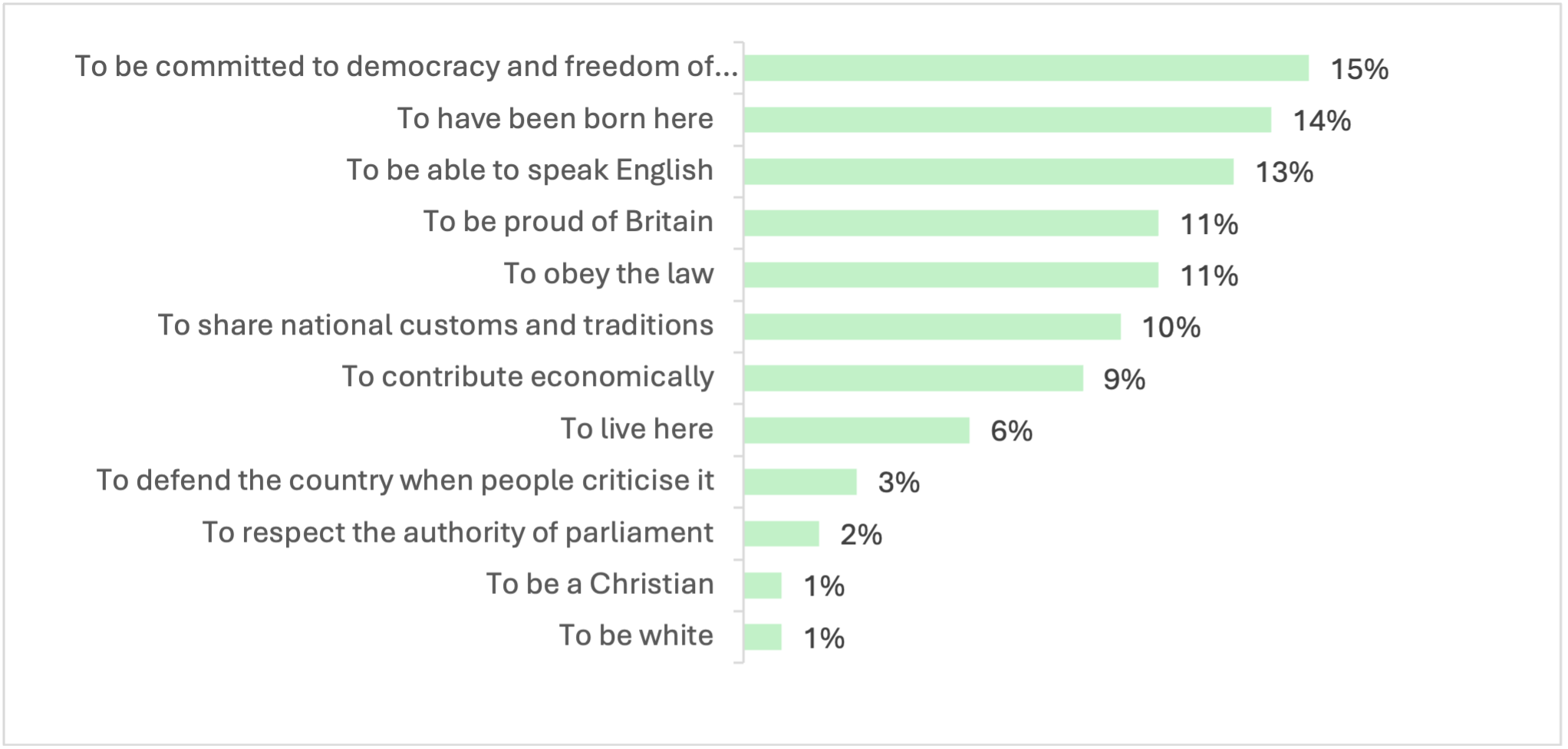
This data broadly preserves the priority ascribed to the factors already discussed.
Commitment to democracy and freedom of speech is considered the most important factor for being truly British by the largest proportion of people (15%) instead of obeying the law, which had the highest balance of public opinion (1.31), but obeying the law is still considered the most important factor for being truly British by 10% of people.
At the other end of the scale, being Christian and being white are considered the most important factor for being truly British by just 1% of people, which is where one would expect those factors from the agree/ disagree data discussed earlier.
In other words, there is broad correlation between a factor being generally agreed to be important and it being considered most important. There are two noteworthy exceptions, however, which can be seen in Figure 4.
Figure 4: The correlation between a Britishness factor being considered important (“agree”) and it being the “most important”.
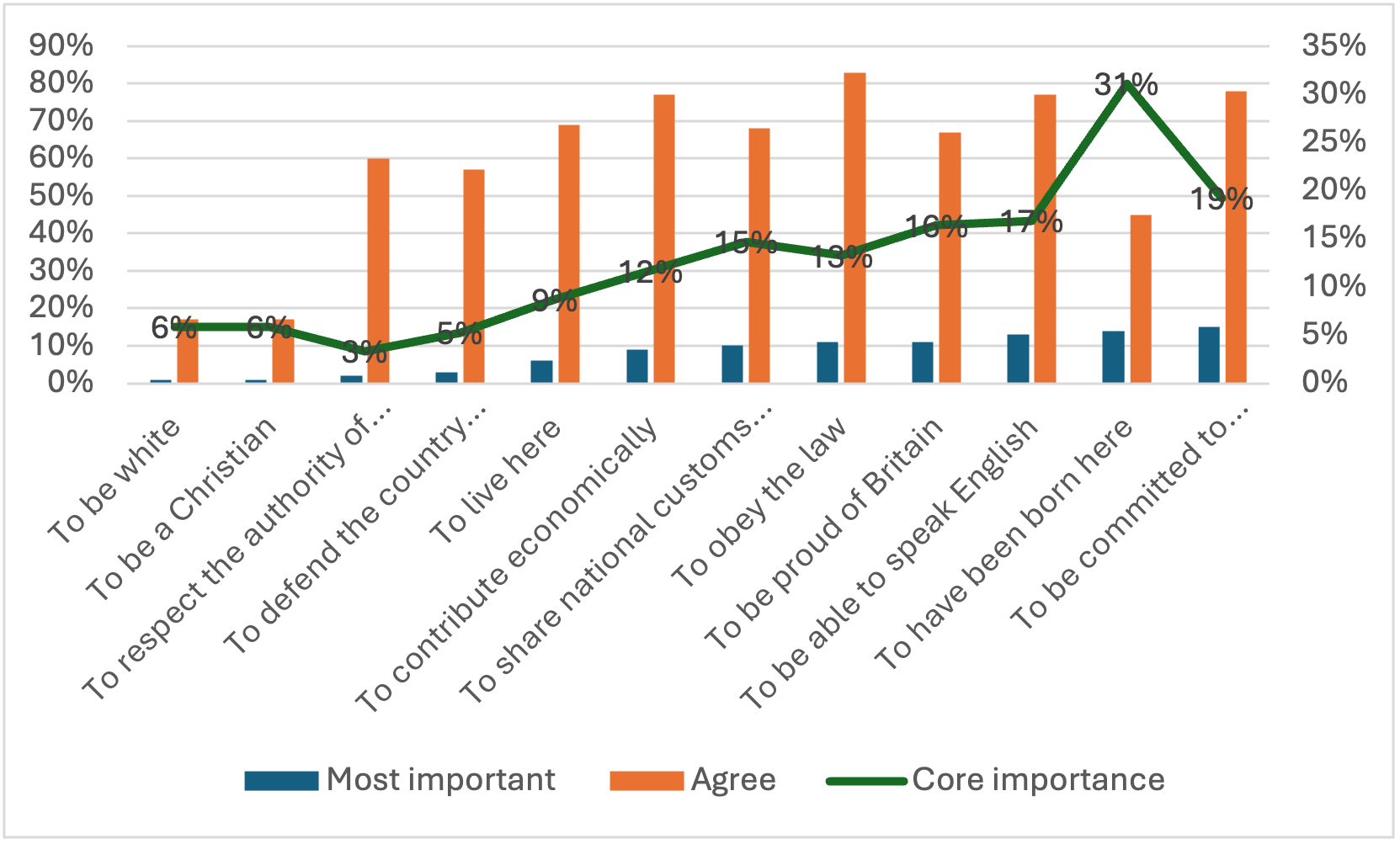
Figure 4 plots the percentage of people who agree (slightly or strongly) that a factor is important to being truly British (red bar) and the percentage of people who say that it is the most important factor to being truly British (blue bar) – both measured on the left–hand scale. It then also measures what proportion of the former think the latter, i.e. what proportion of people who think a factor is important actually think it is the most important. It charts this with a green line, on the right–hand scale (and has data labels).
For example, 78% of people think that being “committed to democracy and freedom of speech” is important to being British, and 15% think it is the most important thing (right–most bars). That means that nearly a fifth (19%) of those who agree that commitment to democracy and freedom of speech is important, think it is core, or “most important”.
At the other end of the scale, 17% of people think that being Christian is important to being British, but only 1% think it is the most important thing, meaning that around 1 in 20 (6%) of those who agree that Christianity is important to Britishness, think it is of “core importance”. The same proportion applies for being white.
This measure is helpful because it draws out how big the core to any view is; in other words, so to speak, what proportion of people who have an opinion here are prepared to die on that hill. For most factors it is between 10% and 20%.
However, there are some outliers. Comparatively few people consider Christianity or being white as core to Britishness, and even fewer (5%) consider defending the country when people criticise it as being core. It appears that Christian nationalism, ethno–nationalism, and “my country right or wrong” nationalism are rarely considered core to being British.
Similarly, only 3% of those who agree that this is important for being truly British, think it is the most important factor. The unpopularity of parliamentary politics (and possibly the rise in nationalist movements across the UK[6]) is visible here and while this is hardly news, it is still noteworthy. Preserving the strong sense of political/ civil identity and loyalty that still dominates feelings of Britishness is made harder when ever fewer people respect the keystone of that identity.
There is another outlier, in the opposite direction. While 45% of people think that being born in Britain is important for being truly British (the third lowest figure), nearly a third of them, or 14% of the population overall (the second highest figure), think it is the most important factor for being British. In other words, a disproportionately high number of people who favour some form of natal identity and loyalty believe it is the core issue when it comes to Britishness. It seems that this, rather than any older and more familiar kinds of (white) ethno–loyalty is where the more “ascribed” nationalistic sentiments currently reside.
What issues preoccupy different ideas of Britishness?
Finally, how do different concepts of national identity and loyalty map onto political and social concerns today.[7]
We simplified the dimensions outlined above into four distinct categories, each of which had a sufficiently large sample base on which to conduct analysis. (The other dimensions of identity discussed above – geographic, economic and religious – do not have large enough sample sizes to test.) The four categories selected were:
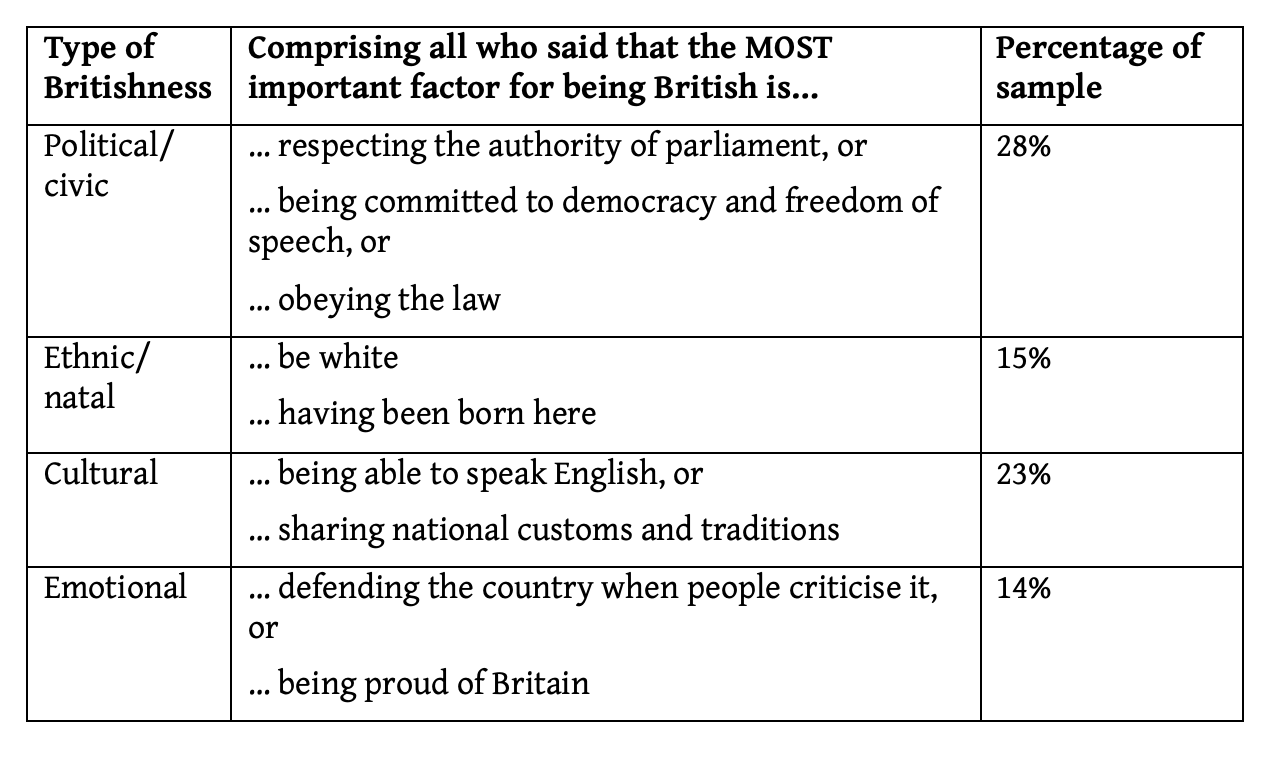
We then analysed people’s current social and political concerns according to their conception of Britishness. The top three issues for each of the four kinds of national identity were as follows:
Table 1: Top three issues of concern in UK today (very concerned by conception of Britishness)?
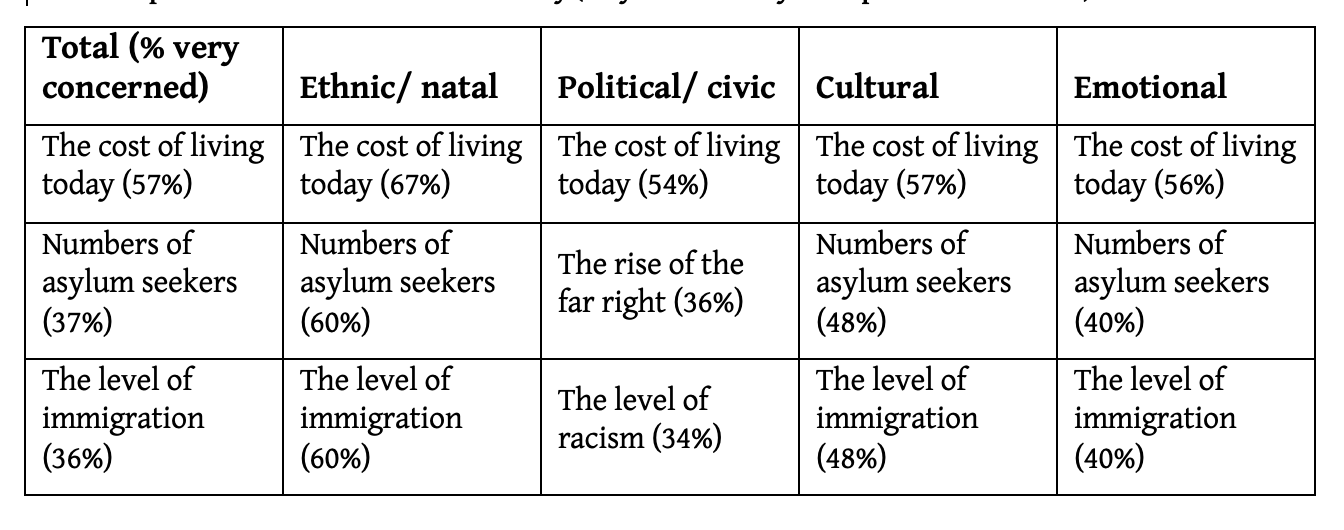
“The cost of living” was the topmost concern for all different groups, but after that there was a marked difference between the concerns of political/ civic nationalists (who were concerned about the rise of the far right and the level of racism, and other groups, whose concerns were asylum and immigration.
We then examined which issues different groups felt very concerned about compared to other groups.
Table 2: % very concerned about [issue] for Britain?
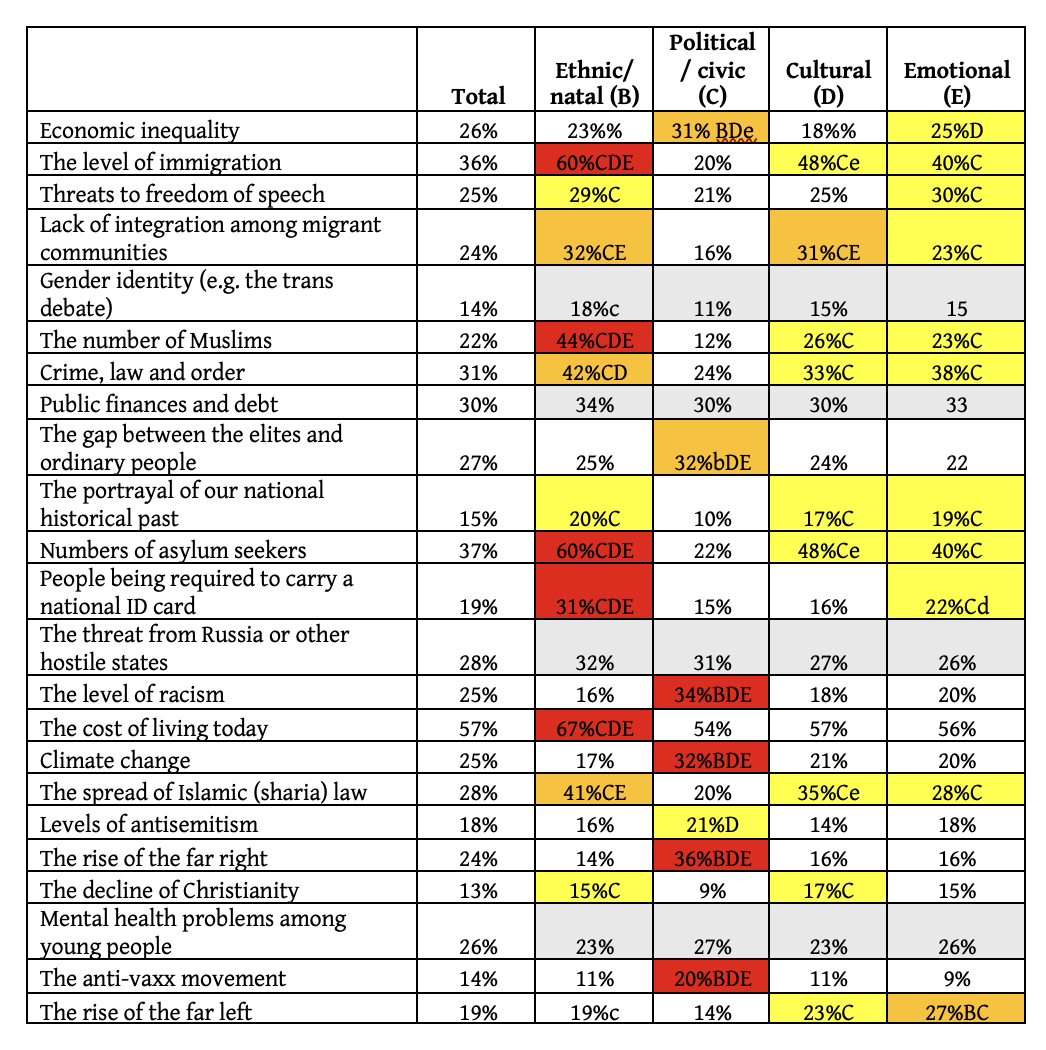
Table 2 above records what percentage of each group (plus what percentage of the total) said they were very concerned with an issue. Different figures have different shading to give an indication of how to read each ‘footprint’. More precise definition can be read in this footnote[8], but in essence
– Red indicates a strong level of difference between the opinion of the group on the issue to hand, and the opinions of all three other groups.
– Orange indicates a strong level of difference between the opinion of the group and those of two other groups.
– Yellow indicates a strong level of difference between the opinion of the group and that of one other group.
– Grey indicates no meaningful difference at all between groups.
A number of points can be made about these results.
First, there are only a handful of issues that elicit no meaningful difference at all between people according to their understanding of Britishness. These issues are shaded in grey: gender identity (e.g. the trans debate), public finances and debt, the threat from Russia or other hostile states, and mental health problems among young people. Note, this does not mean people are not concerned about these issues but rather that their conception of what it means to belong to Britain does not appear to affect how concerned they are about this issue.
Second, those who have an ethnic/ natal or a political/ civic idea of Britishness are intensely exercised by a handful of (different) issues each. The ethnic/ natal group are particularly focused on the level of immigration, the number of Muslims, and the number of asylum seekers but also, notably, the cost of living today, and the issue of national ID cards. Rather differently, the political/ civic group are particularly anxious about the level of racism, climate change, the rise of the far right, and the anti–vaxx movement.
By comparison those who have primarily a cultural or emotional conception of Britishness are less intensely exercised by these (or indeed) issues. To be clear, it is not that cultural or emotional nationalists are unconcerned by these issues facing Britain today, but rather their conception of what it means to be British does not correlate with any particularly strong social or political anxieties at the moment. Where they do, as indicated by the prevalence of yellow boxes on the two right hand columns on the table (and more specifically by the letters next to the statistics), the cultural or emotional nationalists are marked out as being different from the civic/political nationalists, rather than the ethnic/ natal ones. In effect, holding a cultural or emotional concept of Britishness inclines you in the same direction as holding an ethnic/ natal, but with less intensity.
There is an intuitive logic to much of this. Ethnic/natal “nationalists” are more concerned about who is living in the UK, and are more inclined to reject outsiders. Political/ civic “nationalists” are not concerned with who lives here but they are with how they get on with one another, and are especially worried about factors that they consider to be divisive.
Beyond that, however, it is worth noting that:
– Although ethnic/natal “nationalists” are not especially bothered about economic inequality, they are disproportionately concerned with the cost of living. In other words, there is likely to be an economic dimension to their ethnic/natal concerns.
– There is almost no co–incidence between the felt concerns of ethnic/natal “nationalists” and political/ civic “nationalists”. These two, at least, do feel like two tribes.
– Over a third of Britons prefer neither an ethnic/natal nor a political/ civic idea of Britishness, but instead favour a cultural or an emotional form of identity and belonging, and if these feel like softer forms of “nationalism”, it is probably because they are. People in these categories are far from indifferent but also less animated about social/ political affairs than those in other groups. In other words, while there are political tribes at work in relation to different conceptions of Britishness, that does not mean the whole landscape is tribal.
Conclusion
The Brexit vote, and the ensuing three–year parliamentary hokey–cokey, was a difficult and tense time in British public life, with many sensing or prophesying a decisive shift in our idea of Britishness, away from a civic/political model and towards a more exclusionary ethnic/ natal one.
In reality, things were always more complex when it came to British identity (the question of English identity is very different of course, and no less complex). When British Social Attitudes measured conceptions of national identity more than twenty years ago, splitting identities according to civic and ethnic ideas, they found that just 23% (in 1995) and 32% (in 2003) of people had a civic–only understanding of Britishness.[9] The majority of people – 63% in 1995, 58% in 2003 – had a mixed ‘civic and ethnic’ idea. (Very few people had an ethnic–only conception). In other words, the lines between these well–established conceptions of identity are vaguer and more permeable than might appear to be the case in theory, or indeed from the above data on the apparently incompatibly different concerns of ethnic/ natal vs political/ civic groups. Something of that blurring is captured when you factor in those who prefer to hold to more cultural or emotional forms of national identity.
Either way, the data presented in this essay strongly suggest that the civic/political conception of Britishness remains predominant, in spite of news stories that have stoked anxieties about the slide towards angry, exclusive, ethnically–flavoured nationalism. We should be aware of this before we sound apocalyptic trumpets about the state of society.
All that noted, and factoring in the point just made about the permeability of boundaries in this whole debate, while the differences between ethnic/ natal and political/ civic categories are real and clear, the two categories are not unrelated.
Some people will have immutable opinions on what it means to be British, and nothing will change that. However, many will not and it is quite possible, for example, to imagine that some, who once held a more civic/political idea of Britishness, could relinquish it because they feel that national politics is no longer functioning as it should, and therefore no longer a satisfactory source of identity, belonging or pride.
Were that to be the case, these people might not slide all the way from a civic/political idea of Britishness to an ethnic/ natal one, but move to a more moderate and less intense emotional or cultural view of the nation. That may be what we are seeing.
Either way, however much the public still favours a civic/political idea of Britishness, and however much the lurid anxieties of public life being transformed by a tide of ethno–nationalism after Brexit were overdone, it would be wrong to assume that the civic/political identity is secure. Because of its very nature – an achieved rather than an ascribed identity – it needs to ‘perform well’, and could therefore be seriously eroded by waves of political frustration and anger.
Interested in this? Sign up to our mailing list to be the first to hear about Theos’ work on Christian Nationalism.
]]>
Nick Spencer speaks with Alan Manning, Professor of Economics at LSE and former chair of UK government’s Migration Advisory Committee. 16/05/2026
Immigration is a major issue in the contemporary world, a – if not the – driver of nationalist movements the world over. It is impossible to think about nationalism today, religious or otherwise, without thinking first about immigration.
But immigration is also a hard subject to think about, not because of a paucity of information but because of a glut. Awash with statistics, anecdotes and personal stories, immigration offers people a well–stocked cupboard of things to feed their existing views and opinions.
So, what is the truth behind immigration? What are the actual numbers? What are the benefits? And the harms? And to which people? Immigration policy is notoriously tough – is there are way to think clearly about it and make it any easier?
Nick Spencer speaks to Alan Manning, Professor of Economics at LSE and former chair of UK government’s Migration Advisory Committee, about his latest book, Why Immigration Policy Is Hard: And How to Make It Better.
You can purchase a copy of his book here.
Listen to the episode on Apple Podcasts here.
Interested in this? Share it on social media. Join our monthly e–newsletter to keep up to date with our latest research and events. And check out our Supporter Programme to find out how you can help our work.
]]>
George Lapshynov reviews the new Steven Spielberg film ‘Disclosure Day’. Would alien life threaten Christian belief? 15/06/2026
Steven Spielberg has always looked to the skies for a certain kind of grace. In Close Encounters, the heavens open in light and music. In E.T., the little stranger dies and then comes back to life, showing a lonely child the way to love. The religious imagery was never exactly hidden, but it was usually carried by wonder.
Disclosure Day is different. This time, Spielberg does not merely borrow Christian imagery. He places it centre–stage and asks whether it can survive the plot.
The set–up is familiar enough. A whistleblower has proof that alien life is real. A shadowy corporation wants to keep it secret. The world must be told. Somewhere in the middle of this, a former Catholic novitiate nun worries that revealing extraterrestrial life will make people treat the aliens as gods and abandon their faith. Another (wiser) nun reassures her that God could perfectly well have created life elsewhere too.
So far, so reasonable. Christians do not need to panic at the thought of intelligent life beyond Earth. My colleague Nick Spencer recently made the point well: the discovery of aliens would not make Christianity “ridiculous”, as Tom Paine once claimed. Medieval theologians were speculating about “the plurality of worlds” long before Hollywood discovered flying saucers. There is no Christian dogma requiring alien life to exist, nor one forbidding it. If God is the “Maker of heaven and earth, and of all things visible and invisible”, then other creatures, however strange, would be creatures of the Creator too. They might enlarge our imagination; they would not displace God. A larger universe is certainly not an embarrassment to the Gospel, as it is already held within it.
The problem is not that it asks this question. It is that it seems faintly pleased with itself for having asked it at all. The film portrays Christianity as a provincial belief system that is easily disturbed by changes in our understanding of the world. The moment we realise that aliens really do exist, the film suggests, we will see crucifixes trembling, nuns wavering in their faith, and the faithful rushing to trade the Creed for a UFO press conference.
This is not serious theology. It is a straw man with (in this particular case) a rosary.
To be fair, some of the Christian reaction online has not helped. A small fake scandal erupted around the claim that Spielberg had said Christians would start “second–guessing their own religion”. In reality, he raised the perfectly legitimate question of what a real ‘disclosure’ would do to people’s “fundamental beliefs” and asked whether God is God only on this planet or in every alien civilisation. It is also a question to which Christianity already has better answers than Spielberg appears to realise.
Yet my actual issue with the film is not its misunderstanding of Christianity. It is the salvation story that replaces it.
Jonathan Pageau, in his typical way, has described Disclosure Day as a “late–boomer propaganda film”: aliens as saviours, empathy as the supreme virtue, the mainstream media as priesthood, revelation as broadcast event. One does not need to follow every part of that (occasionally tenuous) reading to see the central point that the aliens are not simply neighbours; they are moral instructors. They arrive, or are revealed, as higher beings whose suffering exposes our cruelty and whose message can rescue us from ourselves.
This is an old trope now. Humanity is violent, divided, selfish and stupid. Then the ‘visitors’ arrive from beyond the stars, purer than us, wiser than us, somehow less compromised by history, sin, politics, and no doubt, social media. They show us that we must choose empathy. Everyone looks up. The music track swells. Salvation descends, tastefully backlit.
The absurdity is that these cosmic redeemers’ apparent saving mission begins with children being lured away into the woods, taken to “Hansel and Gretel’s house” – which turns out to be the aliens’ spaceship – and left with trauma so deep it marks them for decades. An odd first move as saviours go.
Glorification of kidnapping aside, there is something deeply revealing about this. For all that elements of modern secular culture still find the Christian idea of salvation implausible, embarrassing, even dangerous, it remains hungry for salvation all the same. It wants revelation, transcendence, grace, and a messiah who asks only that we be nicer to one another – only without repentance, judgement, or God.
Empathy is certainly not a bad thing. God forbid a Christian think tank should speak out against it. But empathy alone is a very thin gospel. It does not tell us what is true. It does not tell us what is good. It does not tell us how to order our loves, forgive our enemies, restrain our desires, or face death. It is a good feeling more of us should feel, but not a panacaea.
That is why the film’s (surprisingly abundant) Christian imagery jars. The crucifix, the nuns, the stigmata–like wound, the language of revelation and divine beings: all of it gestures towards something deeper than the film’s actual superficial message.
Disclosure Day is a good watch. Emily Blunt is tremendous. Even now, there is something moving in Spielberg’s refusal to surrender wonder. However, this sentimentality is rather disappointing: the aliens are kind, humans are bad, and empathy will save us all.
The good news for all who panicked online is that Christians do not need to second–guess God because Spielberg has rediscovered UFOs and very cliché–looking little green men. We might, however, second–guess Hollywood’s habit of treating Christianity as the fragile superstition from which its own thinner myths can liberate us.
The aliens may or may not be out there. But they are not coming to tidy up our politics, heal our divisions, or save us from ourselves.
Interested in this? Share it on social media. Join our monthly e–newsletter to keep up to date with our latest research and events. And check out our Supporter Programme to find out how you can help our work.
]]>Nick Spencer speaks with writer, comedian and broadcaster Andrew Doyle. 09/06/2026
“Woke” has become one of the most contested words in contemporary culture, deployed as a badge of honour by some, a term of abuse by others. But what does it actually mean, and does it constitute a serious ideological movement or merely a passing fashion?
In today’s episode, Nick talks to writer, comedian and broadcaster Andrew Doyle, best known as the creator of satirical persona Titania McGrath, whose latest book The End of Woke examines the origins, methods and possible decline of the movement. They discuss how woke ideology captured institutions, weaponised language, and confused equity with equality – and why the real threat, left or right, is always authoritarianism in disguise.
You can buy a copy of his book here.
Tune in to the episode on Apple Podcasts here.
Interested in this? Share it on social media. Join our monthly e–newsletter to keep up to date with our latest research and events. And check out our Supporter Programme to find out how you can help our work.
]]>
Chine McDonald explores the recent backlash against our cultural obsession with self–optimisation. Can we resist the pull of productivity? 04/06/2026
Businessman Steven Bartlett – whose influential podcast Diary of a CEO has gained more than a billion listens – has come under fire in recent days for saying that having two glasses of wine “ruined” three days of his life “because of the domino effect that it caused”. Bartlett laments the horror of getting worse sleep that night because of the alcohol, eating poorly the next day because his “dopamine system or the cortisol system or whatever was all messed up”. He then – horror of horrors – “podcasted worse” and didn’t go to the gym the day after. All of his supposed failures could be tracked on his various self–optimisation devices.
The response has been fascinating. Radio 1 presenter Greg James called on people to join him in the anti–optimisation movement because “optimisation is killing fun”, he said. He also might have a book out saying just that.
The backlash to Bartlett’s comments have been less about the specifics of enjoying alcohol (some applauded those who have managed to give it up entirely), but the sentiment was more a tirade against the ‘optimisation movement’ which uses data, technology, life and productivity hacks to improve quality of life. That is, if we measure the quality of life by how much we achieve, how much of our to–do lists we blast through, how much money we make, and how much our bodies are optimised health–wise to achieve the said goals.
We start each weekly team meeting at Theos with an icebreaker question. I regret asking the team last week to share the most ‘self–optimising’ thing they have done recently. Some bristled against the question; some of my colleagues rightly pointed out that we shouldn’t be falling into the trap of thinking that the self–optimising way is the right one. After all, one of the key societal narratives we as a team are hoping to counter in the world through the wisdom of Christian scripture and tradition, is exactly this concept of self–optimisation. Nevertheless, we all had answers: ranging from increasing vitamin intake to lifting weights to being trained on how to use AI.
We were reminded of our senior researcher Hannah Rich’s excellent long read in which she interviews members of religious orders about their rules of life that counter this idea that we are what we achieve. The piece begins with a striking quote from the novel Stone Yard Devotional, which tells the story of the protagonist who flees to a convent in the Australian outback:
“Being here feels somehow like childhood; the hours are so long and there is so much waiting, staring into space. Absolutely nothing is asked of me, nothing expected.”
I confess that I find in this quote both liberation and terror. It’s hard to resist the pull of productivity and self–optimisation when life feels overwhelming. Self–optimisation isn’t all bad, but rather a very human attempt to provide control, order and habits that we think might lead to a better life, especially when the world feels so turbulent. And yet the pull of nothingness – of just being – is a very human hope, too. But it feels counter–cultural because, as I heard Romanita Hairston say so powerfully at Washington National Cathedral last week: “We have not yet learned how to be valuable without being useful.”
She was speaking at The Understory festival, which Theos partnered in, and which a few of us attended in Washington DC last week. Run by our friends at Comment magazine, the inaugural festival gathered civic, institutional and faith leaders to explore what Christian humanism in particular might offer into this fragile and turbulent political and cultural moment. Anne Snyder, Comment’s editor and creator of the festival, explained the concept of the ‘understory’ as the “hidden unity” beneath the world’s fracture. “Something real and raw is stirring beneath our disordered politics and performance,” she said.
What has this got to do with Steven Barlett’s two glasses of wine and the backlash to a culture of self–optimisation?
What I see in the anti–optimisation movement is an understory emerging that is dissatisfied with the overstories we have been told about who we are. Beneath the overstory that tells us we need to be endlessly productive and optimised to feel ok about ourselves is a desire to express to another person: I think we’re made for more than this. Do you? Or as Czech theologian Tomáš Halík told those of us gathered in DC: “Humanity has had the intuition that we are more than what we currently are.” On Tuesday, back in London, at an event we held at the Royal Society of the Arts on behalf of the Fetzer Institute on the launch of their new book, we discussed too the sacred understories that lie beneath the so–called secular; and encouraged society across sectors to pay more attention to them.
As we see an increasing resistance to the belief that the overstories we have been told to believe are the only stories, perhaps, as Romanita Hairston said, “there is an understory of connection that is not fuelled by the name tags that we wear.”
I think a Christian understanding of what it means to be human can help us in this moment to put language around what feels instinctive to many, whether they are ‘religious’ or not. People are increasingly turning to the wisdom and steadiness of faith traditions to help us make sense of what we’re going through. For example, could any of us have predicted that in 2026 the pope’s encyclical would go viral? And yet Pope Leo’s Magnifica Humanitas has received mainstream coverage the likes of which we’ve never seen.
And that podcast I mentioned at the start of this piece – Diary of a CEO? Well, the latest episode out today is Steven Bartlett in conversation with none other than last year’s National Parliamentary Prayer Breakfast speaker, Christian apologist John Lennox.
In these times of hunger for things that can hold us in this moment, the role of organisations like ours is perhaps to connect the understories bubbling under the surface to a story – and a person – that might help us. In the gospel accounts, when a rich young ruler asks what’s needed for him to gain eternal life, Jesus in effect tells him to let go of all the things that he might find security in and give it all away. For our self–optimisers today, that might be the wealth and the sleep trackers and the things we might grip on to for dear life; the constant need to save time or to master it for our own purposes.
Perhaps Oliver Burkemann is getting to the truth of Christ’s response to the human need to both achieve and control and produce when he writes:
“There is an alternative: the unfashionable but powerful notion of letting time use you, approaching life not as an opportunity to implement your predetermined plans for success but as a matter of responding to the needs of your place and your moment in history.”
Interested in this? Share it on social media. Join our monthly e–newsletter to keep up to date with our latest research and events. And check out our Supporter Programme to find out how you can help our work.
]]>
Theos, the Fetzer Institute and LSE’s Faith Centre recently held an event at the RSA on ‘Exploring Sacred Stories in a Secular Age’, to mark the publication of the Fetzer book Retelling Sacred Stories. Senior Fellow, Nick Spencer opened the event with an exploration of what it means to “speak” human.
Daniel Everett is one of the world’s leading scholars of language, but he started out as a missionary among the Pirahã people, a small, indigenous group living in an extremely remote part of the Amazonian rainforest.
Everett was an SIL missionary, SIL standing for Summer Institute of Linguistics, an evangelical nonprofit organisation whose main purpose was to study, develop and document languages, so they can translate the Bible into them. That meant that, unlike the popular idea of the missionary, Everett’s role was not so much to speak to the Pirahã people but to listen to them. He, and SIL, worked on the principle that if you really want to understand, communicate, connect with – and ultimately help – other people, you must spend your time and energy among them and in particular listening to how they use words. The experience, as he discovered, can be both enlightening and disturbing.
Now, let me beg your indulgence and ask you to imagine a cosmic missionary, a kind of Martian anthropologist, who wants to do for the human species what Everett did for the Pirahã people. It – because I don’t want to speculate about how many Martian genders there are – does a bit of research first. It discovers, courtesy of reading some of the academic work – our Martian is a big fan of Robert Bellah, Robin Dunbar and Neil MacGregor – that our species has long, indeed always, been, for want of a more precise phrase, “spiritually engaged”. For almost as long as we have records of our species, those records show our preoccupation with the sacred.
It shows up in our material culture, in the statues, temples and votive offerings that can be found the world over. It shows up in our fascination with ritual, prayer and meditation. But above all it shows up in the way we talk. Wherever you go in the world, whatever age it looks at, the Martian finds words like “soul”, “spirit”, “sacred”, “presence”, “holy”, “eternity”, in texts it looks at. And it also notices that humans tend to use words like love, mercy, justice, compassion not as if they are contingent and malleable things in the world, but as if they had some kind of permanence to them and some kind of authority over us; as if, in short, they were transcendent phenomena.
And so, just as Daniel Everett learned to speak Pirahã in order to connect with that people, so our Martian realises that if it wants to connect with this species, it’s got to learn to use these terms, to speak “spiritual”.
But our cosmic anthropologist is not naïve. It realises that some parts of the world appear at least to have abandoned the religious infrastructure that supported this spiritual language. And it also realises that attempts to define and determine the meaning of these spiritual words has proved largely fruitless. Our Martian is well aware that certain philosophers have tried to define the ‘soul’, and certain anatomists have tried to locate it, and certain cranks have tried to weigh it – and none of them has met with much success. So perhaps, our Martian anthropologist thinks, the human species is seeing a gradual evolution of language and that maybe, as TS Eliot wrote, “last year’s words belong to last year’s language, and next year’s words await another voice.”
But then the Martian looks again. Are we really losing our religion as a species? Our Martian finds out, courtesy of the Pew Forum, that around 84% of the species today is “religious” and that this is forecast to increase to about 87% by 2050.[i] And – and this is a crucial fact – even in those places where that religious infrastructure appears in a state of decay, people still speak spiritual.
Listen to what people say, what they write. They still use the language of soul, spirit, sacred, presence, holy, eternity, transcendence – even the most non–religious of contexts – as if nothing has changed. Moreover, this isn’t simply a hangover from the past, in the way the language of “sunrise” and “sunset” is a hangover from a geocentric cosmology, because the way we use such terms today was the way we always used to: figuratively, imaginatively, and above all narratively.
When we say today that my yearns for something, we are not making a poorly–phrased statement about how hungry we are. When we say, we feel the inexorable pull of compassion or mercy, we are not making a statement about Newtonian mechanics. When we say someone has a sacred aura about them, we are not talking about a smell they emit. Rather, we are reaching for a language that reflects the deepest, most heartful, most stubborn, most important ideas and experiences we have of being human.
Some of the earliest human documents we have are about trade and tax – and that surely says something about us. But many of the others relate to offerings to the gods, to rituals, to priestly records, to hymns, to funerary formulas. And many of these, from at least 4000 years ago, are narrative in form. Very often, though by no means universally, our spiritual language is embedded in stories. Our Martian anthropologist realises that not only must he learn the language, but also their narrative grammar.
I’ll drop the analogy now but you will, I hope, understand the point I was trying to make. 240 years ago the great Scottish poet Robert Burns wrote the glorious–entitled verse “To a louse”, which contained the lines:
Oh, would some Power the gift give us
To see ourselves as others see us!
That is what viewing our species through the eyes of a cosmic anthropologist might help us do. And in doing so it should help underline two points that are central to what it means to be human.
First, we are a spiritual species. Largely irrespective of what we actually believe in any formal sense, and entirely irrespective of what is actually the case – human beings and culture naturally and always gravitate to “spiritual” language. It’s just what we do. We might not be making a religious, let alone doctrinal point, but we need this language – the language of soul, spirit, prayer, sacred, holy, eternity, presence, etc – just to describe the basic human condition and everything that comes with it.
And second, we are a narrative species. Since long before we started writing them down, we told each other stories, as a way of making sense of time, or ourselves, or our world, and yes, of our nagging sense that this is not all there is. Just as the English speak English, and the Pirahã speak Pirahã, humans speak spiritual and we speak narrative. If we are at all serious about understanding, communicating, connecting, helping our species, our selves, we need to do that too. As Retelling Sacred Stories puts it “the elimination of the Sacred severely distorts the human family’s chances for shared flourishing.”
Let me end, by going back to where I started, with a coda which is also a warning. Daniel Everett spent his time among the Pirahã people learning their language so he could translate the Bible for them. In the process, he did end up having conversations with them and in the process he discovered that as soon as he admitted to the Pirahã that he had not personally met Jesus, they were not interested. So much authority did they place on experience or eyewitness testimony that they were not interested in the fact that the evangelists might have met Jesus. Daniel Everett hadn’t & that was enough for them. In one sense their universe was straightforwardly immediate and proximate.
But in other sense it certainly wasn’t. Everett was clear that the Pirahã were not “nonreligious.” They talked all the time about spirits, beings in the forest, supernatural presences, dreams and visions. Everett had to learn that to communicate properly with the tribe he really had to listen, even if it was a disconcerting experience. It’s a good lesson for us today.
Interested in this? Share it on social media. Join our monthly e–newsletter to keep up to date with our latest research and events. And check out our Supporter Programme to find out how you can help our work.
]]>
Nick Spencer reflects on the real meaning of Christian humanism after visiting Washington DC. 03/06/2026
I have just returned from Washington DC where, with colleagues, I attended a seriously impressive conference about Christian humanism. Organised by Anne Snyder and the team at Comment magazine, it was held at the National Cathedral and had over a thousand people. The event, called The Understory Festival, comprised art, music, food, conversation, and numerous first–rate discussions, including an excellent keynote speech by Luke Bretherton, Regius Professor of Moral and Pastoral Theology at Oxford University. Bretherton and others outlined what Christian humanism is and why it is so important for our age. I predict, I hope, we will hear a lot more of it over coming years.
Oddly, however, it was not the festival itself but a visit to the Lincoln Memorial that most powerfully brought home to me the real meaning of Christian humanism.
I had never been to Washington DC before, so I took some time to do the tourist thing. It’s an impressive city, with some outstanding museums (the National Museum of African American History has to be one of the best in the world) and a stretch of land, from the Supreme Court at one end to the Lincoln Memorial at the other that feels a bit like Rome must have done in its heyday. Magnificent, huge, brilliant white, marble and stone, classically styled buildings and monuments loom over tiny humans as they ricochet between them. It’s all very imposing.
But nothing, in my humble opinion, comes close to the Lincoln Memorial. Thirty metres high, 60 metres long, with 36 doric columns, the edifice is pure Eternal City. Already dwarfed as you ascend the 87 steps to the interior, you finally come face to face with the former president, in the form of a six–metre high statue, raised on a 3.4 metre pedestal, all of which weighs 170 tonnes. It is breathtaking and utterly intimidating.
Arriving there on Saturday afternoon was probably the closest I will ever come to experiencing what it must have been like to enter an imperial temple in ancient world. Only, instead of coming face to face with Honest Abe – whose famous Gettysburg Address, with its talk of human equality, is carved into the wall of the Memorial – back then I would have been confronted by an emperor, a man whose power was total, whose recourse to violent force limitless, whose very being was divine, and whose health, authority and victories I would have been required to honour, through the regular offering of incense, wine, or sacrifices. This was power, total, unrestrained, imposed on any and all that fell under its gaze.
To live in such an environment and to have thought in any way differently about imperial power would have been terrifying. Failure to honour the emperor could get you killed. The early martyrdom of bishop Polycarp, dating from the second century, gives you a sense of what was at stake. “They tried to prevail upon him, seating themselves by his side and saying, ‘Why what harm is there in saying, Caesar is Lord, and offering incense’.” He would have none of it. And “turning round he said prophetically to the faithful who were with him, ‘I must needs be burned alive.’” And so it came to pass.
This, ultimately, lay at the heart of Rome. An assertion not of humanity but of power, utterly raw and undiluted, total and final, destroying anything that stood in its way.
Christianity transformed this. In place of the imperial throne, there was the criminal’s cross. In place of imperial strength, there was human weakness. In place of huge marble, there was vulnerable flesh. In place of the imperial power as the image of divinity, there was the broken, tortured human body. Emperor and Christ were both men, both gods. They were both the foundation for all they surveyed. They were both the final word of authority in the world. They were just very different answers to those questions. Humanism was born here. “Behold the man,” Pilate said.
But, before we get too pious and triumphalist about this, there is a caveat. We should not assume that Christianity necessarily protects us from this un–humanistic power and idolatry. To the best of my knowledge, the largest imperial statue in ancient Rome, was that dedicated to the first Christian emperor, Constantine. Christianity has proved pretty adept at banishing divinity from living (political) leaders, and then smuggling it back in through some theological loophole.
And let us also not assume that, even if we acknowledge this tendency, we are therefore protected from such backdoor quasi–deification of human power. As I walked the capital’s streets, I couldn’t help but notice several huge banners of the current president, a man deeply popular with many American Christians, unfurled over government buildings. It felt a bit odd, to be honest. A bit like stepping back in time.
 A banner of US President Donald Trump, photographed by Nick Spencer
Interested in this? Share it on social media. Join our monthly e–newsletter to keep up to date with our latest research and events. And check out our Supporter Programme to find out how you can help our work.
]]>Nick Spencer speaks with theologian Hannah Strømmen. 02/06/2026
Unpalatable truth as it may be, there are some, especially today, who draw on the Bible to exclude and vilify others, as a way of protecting and the “pure” Christian culture of Europe or the West.
It’s not an altogether new phenomenon – people have deployed the Bible for militaristic ends since the Crusades – but it appears to be growing once again, as the Europe comes under “attack” from immigrants and Islam.
How does this happen? What Bibles do the Far Right use? What texts do they quote? What principles underlie that usage? And what can be done about it?
In today’s episode, Nick talks to theologian Hannah Strømmen, whose latest book The Bibles of the Far Right, examines just these questions.
You can buy a copy of her book here.
Listen to the episode on Apple Podcasts here.
Interested in this? Share it on social media. Join our monthly e–newsletter to keep up to date with our latest research and events. And check out our Supporter Programme to find out how you can help our work.
]]>Nick Spencer speaks with journalist and author Sonia Faleiro 26/05/2026
Buddhism is often seen in the West as a religion of peace and serenity – rarely, if ever, associated with violence. But that comforting image has obscured a darker and more complex reality playing out across Southeast Asia.
Journalist and author Sonia Faleiro joins Nick Spencer to explore her latest book The Robe and the Sword, which examines how Buddhist nationalism has fuelled ethnic tension, discrimination, and outright genocide in Sri Lanka, Myanmar, and Thailand. From the militant monks who emerged out of Sri Lanka’s brutal civil war, to the Facebook–driven hatred that preceded the Rohingya genocide in Myanmar, the patterns Faleiro uncovers are uncomfortably familiar to anyone watching the rise of religious nationalism elsewhere in the world.
You can buy Sonia’s book, The Robe and the Sword: How Buddhism is Shaping Modern Asia, here.
Listen to the episode on Apple Podcasts here.
Interested in this? Share it on social media. Join our monthly e–newsletter to keep up to date with our latest research and events. And check out our Supporter Programme to find out how you can help our work.
]]>
A team of our researchers attended the Unite the Kingdom rally last weekend to investigate the rise of so–called “Christian nationalism”. 22/05/2026
“How many of our daughters have to be taken?…that’s the real cost of mass, open borders immigration…An invading army of men brought into this nation…raped and pillaged their way through it… a rape jihad”.
These were the words of Tommy Robinson (a.k.a. Stephen Yaxley–Lennon) at the Unite the Kingdom rally last Saturday. Tommy Robinson, a prominent far right and anti–Islam activist, recently announced his conversion to Christianity, contributing to growing discussions about the rise of so–called “Christian nationalism”.
In response to the increasing prominence of Christianity in our political debates, Theos is engaged upon a new stream of work exploring Christianity and ideas of nationhood in UK and across Europe. To try to gain more of an insight into how Christianity and nationalism intersect for those occupying political spaces like Unite the Kingdom, a team of Theos researchers decided to attend UTK for ourselves. We deliberately sought out attendees who were wearing or carrying Christian symbols or signs and spoke with them to try to understand how and why they had found themselves at such a controversial event.
Walking up to Parliament Square, our eyes met a sea of flags: Union and England flags, but also Israeli, Imperial (Pahlavi) Iranian, Welsh, Cornish, Irish and Scottish. There were a great many who fitted the usual media stereotypes: white, middle–aged men whose style and swagger felt football–hooligan coded; the baggy tracksuits and chain necklaces with flag–come–capes on backs were a common sight. Some had been drinking and the odd one at the fringes was making a bit of trouble. Speaking to some attendees, we found they had travelled (sometimes alone) from as far afield as Blackpool, Devon, Norfolk and Lancashire, as well as parts of Essex, East London and Kent. They were keen to interact and talk to us, many seemingly looking for kinship and visibility in a society which had often made them feel invisible and disposable. Coming to London was, for some, an act of civic agency: not democratic participation in the conventional sense, but a journey undertaken because other routes to being heard felt closed.
The variety of people listening was one of the biggest surprises. There were chairs dotted along one side of the square. Small groups of children of various ages scampered in and out of the crowds, often with flags tied around their shoulders. Volunteers in high–vis UTK jackets wandered around picking up discarded beer cans and meal–deal sandwich boxes. One couple we met explained that they’d come last year and that it was great community event for celebrating Britian. We were struck at how much of a calm, open and generally ordinary, retirement–age they were. We could easily imagine them sitting in the café at the local garden centre, having just wandered around the selection of gnomes and terracotta pots. At times, the rally felt almost like a festival. And whilst white men were the majority, there were also the “Pink Ladies”, anti–immigration activists focused on protecting on women and girls, and the odd person from an ethnic minority background, including one Black lady holding a sign with “Christ, Culture, Country” and a cross emblazoned on it, and who somehow still looked like she belonged.
Unifying these groups seemed to be a belief that the “the establishment” — whether that be the government and politicians or the media or indeed the established church — were not working for them and did not represent them: “They don’t listen to us, the media just say we’re a bunch of thugs”, was a common refrain. When a series of photographs were beamed on screen in a pantomime–esque “goodies” vs. “baddies” game, it was Keir Starmer’s face that was met with the biggest boos. “Keir Starmer is a w****r” was the crowd’s most popular chant. The only time this was hushed away, was during a minute’s silence for Rhiannon Whyte, a 27–year–old woman who was murdered by an asylum seeker in 2024. Asked who they thought could solve the country’s problems – including if Tommy Robinson himself should stand for office – their answer was rarely a clear endorsement of any party at all – although Restore Britain seemed popular. More often than not, we were met with a shrug and dismissal of the formal political sphere. It was politics just as much as politicians or political parties, that was to blame.
Scattered amongst this mass of red, white and blue were a number of large wooden crosses. One was being held up by a man in his mid–50s. His cross was noticeably larger than some of the others and had hinges on it so that it could be folded away more easily. “I made it myself,” he smiled. We discovered he’d been a Christian since he was 14 and had gone to a range of different Protestant churches in his life, from Pentecostal to mainstream Church of England. “This country cannot succeed as a nation if it does not have Jesus at its centre. We need to go back to that,” he explained. Asked about Tommy Robinson, he reflected carefully: “Clearly, he’s done some bad things, but something happened to him in solitary confinement and he became a Christian; there’s a rawness about him, you know? And beneath that rawness is an important message”. That message, for this particular man, was that we need to “go back” to Jesus. He was one of a number of Christians present who seemed serious and practising.
Like many of “the usual suspects” who condemned the “Islamisation” of Britain, often using vitriolic language in doing so, these Christians did often speak of wanting Britain to be Christian. But theirs was not a longing to return to England’s green (or rather, white) and pleasant land. Rather, it was a desire for re–Christianisation from below: revival, repentance, evangelisation. Even, as some put it, a new reformation.
These Christians’ opposition to Islam was real, that is certain. But their opposition was not simply defined by what Britain should be against but rather, however controversially, what they believed Britain should become. That was a New Jerusalem yes, but not one of conquest, crusade and the protection of the white man. Unlike many of the signs carried by some of their compatriots — “I see your jihad and I raise you a crusade” being the most striking example — their rhetoric was generally not coded with violent imagery, but instead characterised by talk of “softened hearts”, and minds opened to the “love and grace” at the centre of the Gospel message.
For one man in his 20s, holding a “Jesus is the way the truth and the life” flag in a St George cross style and wearing a selection of large rings and crucifix necklace, being confirmed as a Catholic at Easter had saved him from himself and given him fellowship and community. He said he was there because he wanted England to be built on Christianity. Another man who ran a right–wing, anti–immigration Instagram channel, explained to us he’d become a Christian in the last few months but really struggled to read the Bible. One of us showed him the Bible app we use on our phone, suggesting he try the short videos and search function to help him get started. He took out his phone, downloaded the app right in front of us and thanked us for the advice.
Some we spoke to who were wielding crosses were not practising Christians but nonetheless had a deep respect for Christianity. They wanted to engage with us and were pleased to see evangelisation at the rally, too. As one man we spoke to from Bedfordshire, who was holding a wooden cross he had picked up at the start of the march, explained: “I am not a God–fearing man, but I believe in the Lord. I don’t go to church, but my nan did. Jesus came first, not Muhammad. I believe we should be loving and our country should be centre on love, that’s why I’m here.” He repeatedly thanked us as Christians for being there, kept apologising for drinking, explaining he had a problem and said we were good people, shaking our hands.
And sincere Christian or not, all this felt completely at odds with Robinson’s call to arms for the battle over Britain and its identity; as did a lone “F**k Islam, Christ is King” sign. A stunt from three French anti–Islam activists, in which they removed burqas to calls of “take it off” from the crowds, was also met with a much more lukewarm reception than the viral media clips suggest – and seemed utterly at odds to the tone of many Christians we spoke to.
Beneath the flags and headlines of a “racist and xenophobic” march, then, we observed something much more complex than social media clickbait or political polarisation will allow. Whilst many of those present who were Christian or Christian–adjacent seemed to converge politically, and almost all were anti–Islam, their journey to the rally was not borne out of the same phenomenon.
For some, that journey began with Christianity, in a belief that Jesus was the way, the truth and the life. Calling for Britain to be a Christian nation was, for them, a natural extension of that. Some seemed uncomfortable with the extremity of language, some were handing out scripture, many had been Christians for a long time. They were not just nationalists reaching for Christian imagery, but Christians whose faith had led them to a distinct, and sometimes uncomfortable, kind of patriotism.
For others sporting Christian symbols, their walk to the march began with national concerns and ended up at Christianity; whether that was an actively developing faith, or simply a deep admiration for it. Their language was more militant; their theology was crude—sometimes almost totally absent — but their openness to us as Christians was striking.
Separate, perhaps, from both groups, was what we saw on the stage – that is, the public presentation of the far–right which, while more sanitised at points than might it have been, was nonetheless still strikingly provocative and at times, aggressive.
What we encountered resists easy generalisations or sweeping judgement. If anything, it highlights the importance of acknowledging the various and frequently complex ways in which faith, identity, and grievance are interwoven in such spaces. It might seem strange to say we found a far–right rally interesting, and there are certainly many millions of Britons who would have been uncomfortable and possibly even in danger there. But it is a worthwhile experience if you want to get to know our new political landscape, or at least one region of it, in its good, bad and sometimes ugly forms.
Theos is publishing research examining Christian nationalism in the UK and Europe. Full research findings and analysis for research countries (UK, France, Germany, Poland, Hungary and Romania) will be published over coming months. Sign up here to receive this research straight to your inbox upon its release.
]]>Nick Spencer speaks with Tobias Cremer, a Member of the European Parliament. 19/05/2026
European Christian politics is not new. Indeed, the religion has been an integral politcal factor for 1700 years. But something has changed over the last 20 years.
Increasingly, a secularised form of Christian politics is taking centre–stage, in which populist leaders celebrate Christianity, but without the Christ bit.
What forms does this secular Christianity take? How does it differ between Europe’s major nations? And why may we be seeing not the Americanisation of European politics (as many claim) but the Europeanisation of American politics?
Nick Spencer speaks to Tobias Cremer, a Member of the European Parliament and former Junior Research Fellow in Religion and the Frontier Challenges at Pembroke College Oxford, about the history of European Christian nationalism, and about his latest book, The Godless Crusade: Religion, Populism and Right–Wing Identity Politics in the West.
Tobias’ book is available to buy here.
Listen to the episode on Apple Podcasts here.
Interested in this? Share it on social media. Join our monthly e–newsletter to keep up to date with our latest research and events. And check out our Supporter Programme to find out how you can help our work.
]]>
This resource unpacks why our cathedrals matter and what you can do to support them. 18/05/2026
What is a Cathedral? Why are they important? And what do they need?
If you’re interested in ensuring that England’s cathedrals are here for generations to come, read our executive summary with practical guidance that get to the heart of how we can best support cathedrals.
Erratum: Earlier versions of this summary document contained a typographical error. On pages 3 and 6, the figure should read 74% (not 77%), consistent with the report and the underlying data.
Interested in this? Share it on social media. Join our monthly e–newsletter to keep up to date with our latest research and events. And check out our Supporter Programme to find out how you can help our work.
]]>
Nick Spencer unpacks preliminary findings from our research on Christian Nationalism. Is it as widespread as we think? 15/05/2026
Headlines
– These are preliminary and tentative findings outlining the size of Christian nationalism in the UK.
– 17% of adults in UK agree that you need to be Christian to be truly British, and just under half of them (8%) strongly agree with this statement.
– Being Christian is considered to be the most important factor (from a list of 12) for being British by only 1% of the population.
– 16% of people in UK agree that people who do not hold Christian values do not belong in Britain, with under half of them (7%) strongly agreeing with this statement.
– Other data, while not measuring this kind of strict Christian nationalism, give a sense of public opinion concerning a looser, but still close, formal relationship between Christianity and Britishness.
– Four in ten people (41%) agree that “the law in Britain should be based on Christian values”, and four in ten people (40%) agree that “religious education in Britain should prioritise the teaching of Christianity ahead of other faiths”, with about half in each case (e.g. c. 20%) agreeing strongly.
– Slightly fewer (37%) think that “the government should formally state that Britain is a Christian country”, although slightly more (22%) strongly agree with that statement.
– Finally, less than a third of people (26%) agree that “it is important for the political leader of my country to be a Christian”, and only 14% strongly agree with that statement.
Introduction: taking care with numbers
This essay is intended to give a preliminary overview of the size and shape of “Christian nationalism” in the UK.
In order to measure “Christian nationalism”, you need to be able to define it. However, as this Theos essay on what Christian Nationalism is pointed out, this is not straightforward. Christian nationalism (we’ll drop the scare quote now) is a slippery term, with lots of different definitions flying around.
Many of those are highly pejorative, with ‘Christian nationalist’ being intended as much an insult as it is a description. The result is that very few who might legitimately fall into this category willingly use or own the description.
If this weren’t challenging enough, there is a risk of self–fulfilling circularity in defining the term. If you can’t ask someone whether they are a Christian nationalist, you need to define it another way. But if you define a Christian nationalist as someone who holds x, y, and z views, it should be no surprise that when you measure what Christian nationalists believe/ want, you discover that they believe/ want x, y, and z.
This can also be away of distorting, usually by exaggerating, the number of Christian nationalists in a country. To take an example of this: if you define a Christian nationalist, as is sometimes done in America, as someone who agrees that “the federal government should allow the display of religious symbols in public spaces”, then you shouldn’t be surprised to find out that Christian nationalists hold this view. It does not follow, however, that anyone who holds this view is therefore a Christian nationalist. Unless we are careful to make this distinction, there is a danger of reading the number of those who favour religious symbols in public spaces as indicating the number of Christian nationalists, thereby inflating the size of the Christian nationalist constituency.
These caveats need to be born in mind when we come to measuring Christian nationalism, and Theos’ on–going work in this area will address these concerns by forms of statistical analysis (more of which anon). In the meantime, we wanted to release initial findings from our on–going work in this area. Accordingly, this essay draws on findings (a) from a new quantitative research study into Christian nationalism that we have commissioned from the market research company RED C and (b) from existing research on this topic from a variety of polling companies and social science studies.
This numerical work takes its cue from the definition of Christian nationalism, described in the Theos explainer, as being about co–terminosity. Christian nationalism is best understood as seeing those two terms – “Christianity” and “the nation” – as somehow coterminous or co–dependent. According to this reasoning, ‘Christianity’ and ‘the nation’ have more or less the same social/ cultural/ moral/ demographic boundaries. In effect, the quickest way of getting a sense of whether someone is a Christian nationalist is to ask them whether they think it is essential/ important to be Christian in order to belong to the nation.
There are various ways of ascertaining this (our survey approaches the point from a number of directions), and a few of these are used below. What is important is to try and keep this question distinct from others factors that are sometimes confused with it, such as whether someone thinks the nation is a Christian country (which is a sociological, cultural or constitutional question), whether someone thinks the nation has always been a Christian country (a historical question), or whether someone thinks the nation should be a Christian country (an ideological or theological question).
The key question is whether you think you need to be Christian to be truly British. What does the research say about this?
How widespread is Christian Nationalism in Britain?
Theos/ RED C research
We asked a nationally representative sample of UK adults whether they agreed with the statement “To be truly British you should… be a Christian”. The results are given in Fig. 1.
Fig. 1: How far do you agree that “To be truly British you should… be a Christian”
Source: Theos/ RED C. Sample 1765 UK adults
A clear majority of UK adults disagreed with the idea that you needed to be Christian in order to be truly British, and a clear plurality strongly disagreed with it. On the other side, 17% of people in UK claimed that you do need to be Christian to be truly British, and just under half of those strongly agreed with this.
This question was asked as part of a wider question which offered other options for being truly British, i.e. “To be truly British you should…
– be white
– contribute economically
– respect the authority of parliament
– have been born here
– be able to speak English
– share national customs and traditions
– be committed to democracy and freedom of speech
– defend the country when people criticise it
– obey the law
– be proud of Britain
– live here
At first, respondents were allowed to tick as many options as they wanted, but then they were asked “which ONE of these factors is MOST important for being truly British?”. When asked this, only 1% of respondents said it was being Christian.
As noted, there are other ways of approaching this question which are less direct and arguably less clearly focused on the ‘coterminosity’ of Christianity and nation, but which are worth noting.
We asked people how far they agreed with the statement “People who do not hold Christian values do not belong in Britain”. The results (Fig. 2) were very similar to the question of whether you needed to be Christian to be “truly British”.
Fig. 2: How far do you agree that “People who do not hold Christian values do not belong in Britain”
Source: Theos/ RED C. Sample 1765 UK adults
Once again, a majority of people disagreed with this statement, and a plurality (and nearly a majority) strongly disagreed with it. Around a sixth of the population agreed with it, roughly split between those who agreed with is strongly and those who agreed with it slightly.
There are other, still looser, measures of the perceived/desired relationship between Christianity and the nation, which are worth mentioning. For example, we also asked people how far they agreed that “it is important for the political leader of my country to be a Christian”, or that “the government should formally state that Britain is a Christian country”, or that “the law in Britain should be based on Christian values”, or that “religious education in Britain should prioritise the teaching of Christianity ahead of other faiths”. It is worth underlining the point made in the introduction that, relevant and interesting as these factors are, they are not direct measure of Christian nationalism, and should not be treated as such. It is also worth mentioning – the perennial challenge with quantitative research – that it is impossible to know exactly what someone means when they dis/agree with a statement like “the government should formally state that Britain is a Christian country” (how? in what forum?), or that “the law in Britain should be based on Christian values” (which values? how explicitly?).
Such caveats noted, these statements given breadth and colour to the core data described above. The results can be seem in Figure 3.
Fig. 3: Agreement on the perceived/ desired relationship between Christianity and Britain
Source: Theos/ RED C. Sample 1765 UK adults
Four in ten people agree that “the law in Britain should be based on Christian values” and that “religious education in Britain should prioritise the teaching of Christianity ahead of other faiths”, with about half in each case agreeing strongly. Slightly fewer (37%) think that “the government should formally state that Britain is a Christian country”, although slightly more (22%) strongly agree with that statement. Finally, less than a third of people (26%) agree that “it is important for the political leader of my country to be a Christian”, and only 14% strongly agree with that statement.
Arguably, these statements measure not the desire for a tightly coterminous relationship between Christianity and Britain, but rather a slightly looser but nonetheless identifiably close relationship between the two. That being so, it is not a surprise to see that a larger number, if never actually a majority of people, agree with these statements.
How does this compare with existing research?
Although Christiain nationalism is a relatively new phenomenon in the UK, there have been some polls and studies conducted over the last ten or so years that cover a similar territory.
In 2012, an Ipsos MORI survey for Channel 4 reported that while 56% of adults said that they thought Britain is a Christian country, and 61% said that it should be, only 4% believed that not being a Christian stopped people from being fully British.[i]
A decade or so later, in 2024, British Social Attitudes published its 41st report which contained a chapter on National Identity, drawing on survey data from the previous year.[ii] This explored what it meant to be British today, looking at certain “civic attributes” such as “to respect British political institutions and laws”, “to have British citizenship”, “to feel British”, and certain “ethnic” ones, such as “to have been born in Britain”, “to have British ancestry”, and “to be a Christian.” This study reported that the proportion of Britons who believed that it is very or fairly important to be a Christian in order to be ‘truly British’ was 19%.
The following year, the US–based Pew Research Center studied attitudes to “the importance of language, customs and traditions, birthplace, and religion as components of national identity.”[iii] Their survey covered 23 countries in North America, Europe, the Middle East, the Asia–Pacific region, sub–Saharan Africa and Latin America, among which was the UK. “Being a member of the country’s predominant religion” was one of the factors tested. This found that 12% of the population considered being Christian “very important” for being British and 17% considered it “somewhat important”. These are higher numbers than that reported for the Ipsos MORI/ Channel 4 survey, but the question is softer, Pew asking about importance, Ipsos MORI about whether, in effect, it was essential.
To these studies, we can add three more from 2025. In 2025, Pew returned to the subject of nationalism from a specifically religious point of view, looking at levels of “Religious Nationalism Around the World”.[iv] This was measured according to people’s responses to four questions, one of which was “how important is belonging to the historically predominant religion [i.e. Christianity in the UK] to being truly part of your national identity?” Pew found that 10% of Britons thought it was very important and 12% considered it somewhat important.
It is worth noting that the other three questions Pew asked in this survey were:
– How important is it to you for your national leader to share your religious beliefs?
– How much influence do you think the historically predominant religion’s sacred text [the Bible] should have on the laws of your country?
– When the sacred text conflicts with the will of the people, which should have more influence on the laws of your country?
The results for the UK were as follows.
Table 1: Importance of Christianity to the nation, from Pew research (2025)
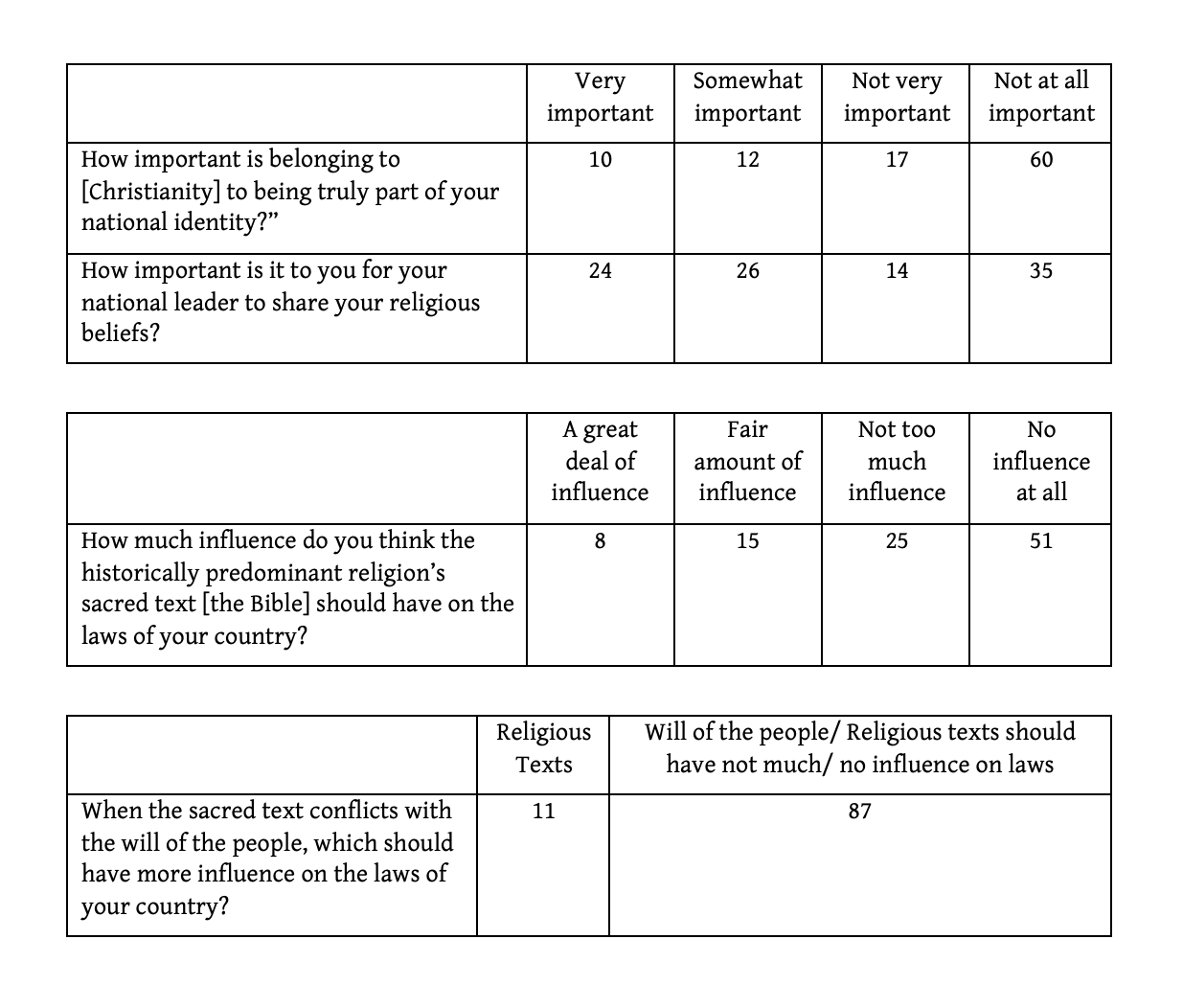
Pew went on to say that for their report “we define “religious nationalists” as people who identify with the historically predominant religion [i.e. Christian in the UK] and take a strongly religious position on all four of these questions”, on which basis only 1% of Britons classified as ‘religious nationalists’. [p. 8] This is obviously a very demanding set of criteria.
Also in 2025, More in Common asked a UK sample if religion was important to whether someone was English. Just over one in ten (11%) of said that it was.[v]
Finally in 2025, the 2025 Ipsos Populism Report asked respondents in 31 countries a battery of questions, among which was how important they thought being part of the religious majority in their country was for being “truly” from that country. When it came to Britain, a quarter (25%) said it was.[vi]
Most recently, a small survey conducted by Premier Christian News in May 2026 (260 adult Christians) reported that 23% of respondents said they identify as Christian nationalists, while 25% described the movement as “godly”.[vii] That said, 93% said they were happy living in a country where neighbours are of different faiths and cultures, including Muslims, Sikhs and others.
Is Christian nationalism in the UK growing or declining?
Because most research in this area is recent (and one–off), it is hard to get a clear idea of the longitudinal trends. Trying to do so via comparing discrete studies is problematic because, however similar questions and surveys are, there are usually small but important differences in wording that render any comparison between them problematic.
The one set of studies that might give some indication of this is the British Social Attitudes survey which has been measuring how “important” people think it is to be Christian in order to be British since the 1990s. BSA found that the proportion of Britons believing that it is very or fairly important to be a Christian in order to be ‘truly British’ has declined from 32% in 1995, to 31% in 2003, to 24% in 2013, and to 19% in 2023.
This would suggest that Christian nationalism has become less of an issue over the last thirty years, which would run counter to the current concerns about a spike in Christian nationalist sentiment recently. However, there are reasons why we might treat these data line with some caution.
Firstly, it only runs to 2023, and the recent interest and apparent rise in Christian nationalism post–dates that. Second, it measures the perceived importance of being a Christian to be British, which is a comparatively weak measure of the phenomenon (and certainly weaker than statements around needing to be Christian in order to be truly British). In that respect, therefore, the BSA data may be measuring something closer to perceived salience of Christianity to Britishness, which has been falling since the 1990s, rather than the slightly different and somewhat harder phenomenon of Christian nationalism itself.
Conclusion
As noted at the outset, Christian nationalism is a slippery term, vulnerable to different definitions and therefore to different assessments of its extent. This essay has looked at initial findings from new Theos/ RED C research into Christian nationalism across Europe, alongside existing studies that explore the same topic.
Although all conclusions must be tentative at this stage, the data here studied suggest that Christian nationalism, being a complex social, cultural, political and religious phenomenon, does not manifest itself as – and is not best understand simply by means of – an “in–or–out” measure. Rather, it is better understood by means of a series of different, and perhaps concentric, groupings.
In this way, there is a tiny group of people for whom being Christian is the single most important factor for being British (Theos/ RED C) or who think it is “very important” that their national leader shares their Chrisitan beliefs, and that the Bible should have a preeminent influence on British laws, and that when the Bible conflicts with the will of the people, the former should have the greater influence, and that being Christian is “very important” to being truly British (Pew, 2025). This is probably no more than 1% of the population.
Then are people who hold recognisably Christian nationalist views, but without the same intensity. They agree that “to be truly British you should… be a Christian” (Theos/ RED C, 2026) or that “people who do not hold Christian values do not belong in Britain” (Theos/ RED C, 2026). They might have agreed (in 2012) that “not being a Christian stops people from being fully British” (Ipsos MORI/ Channel 4, 2012). They might say that it was fairly (or, more likely, very) important to be a Christian in order to be ‘truly British’ (BSA 41, 2024), or that being Christian is “very important” for being British (Pew 2025). They would say that when the Bible conflicts with the will of the people, it is important that the former should have the greater influence on the laws of the country. This group is somewhere between 7 and 15% of the population.
Finally, there are those who want a looser but still strong and formal connection between the nation and Christianity, without seeing the two identities as essentially linked. They agree, for example, that “it is important for the political leader of my country to be a Christian”, or that “the government should formally state that Britain is a Christian country”, or that “the law in Britain should be based on Christian values”, or that “religious education in Britain should prioritise the teaching of Christianity ahead of other faiths”, but they would not go as far as to say it is necessary to be Christian to be British (Theos/ RED C, 2026). This group is somewhere between 15 and 25% of the population.
It is important to stress that these are initial and very approximate categorisations, which will be refined, supplemented (and no doubt) corrected by our on–going analysis of the data.
Research Methodology
More details on the methodology, panel integrity and data quality of this research can be found here.
Interested in this research? Sign up to our mailing list to be the first to hear about Theos’ work on Christian Nationalism.
]]>Nick Spencer speaks with sociologist Andrew Whitehead. 12/05/2026
Christian Nationalism seems to be on the rise – particularly in the US, but increasingly in Europe. The phrase, however, is often used vaguely and carelessly. Indeed “Christian nationalism” can be something of a “dustbin” term, into which people throw all the kinds of things they dislike.
So, what does it mean? What forms does it take and, with a particular focus on the US, what motivates and shapes it?
Join Nick Spencer as he talks to sociologist Andrew Whitehead about what Christian nationalism is – and what it isn’t. You can buy a copy of Andrew’s latest book, Taking America Back for God: Christian Nationalism in the United States, here.
Interested in this? Share it on social media. Join our monthly e–newsletter to keep up to date with our latest research and events. And check out our Supporter Programme to find out how you can help our work.
]]>
What comes to mind when you think of motherhood? There’s more to it than meets the eye, says Chine McDonald. 12/05/2026
When I tell some people one of the themes we at Theos are exploring in our research is ‘motherhood’, or tell them I’ve written a book about motherhood, I can’t help but sense eyes glazing over, or sometimes even a barely perceptible eye–roll. It might be just me, but I can’t shake the feeling that in public consciousness, ‘motherhood’ is followed by apple pie; it’s sweet and saccharine. It’s dull and unintellectual. To some, motherhood is a smug and exclusive club, swinging from moaning about our plight to talking far too much about the love we feel for our children – a love the likes of which you can only experience once you’re in said club, of course. For some, motherhood represents pain: the pain of loss or the pain of that which may never come to pass. It is a topic fraught with difficulty, almost every sentence needing a qualifying statement in case it implies judgment or disregard towards other people’s choices or situations. We talk candidly about the challenges of a Theos team managing several pregnancies and pregnancy losses within the space of a few years in our podcast Motherhood vs the Machine, which has recently been shortlisted for a Sandford St Martin Award.
And yet despite its difficulties, I am more convinced than ever that it is a profound lens through which to look at what it is to be human. Not all of us are mothers, but all of us were born of mothers. Motherhood elicits thoughts and ideas around embodiment, care, politics, the family, citizenship, the economy, the workplace, technology, and spirituality. Motherhood is about literal births of literal children, but at a metaphysical level, it also represents what philosopher Hannah Arendt introduces in The Human Condition as ‘natality’ – the human capacity to begin anew. Writing in and around the Second World War, Arendt describes natality as the opposite of mortality; beginnings rather than endings. In a world which seems ever turbulent, with destruction of systems and democracies and trust, and nations, natality is for Arendt, “the miracle that saves the world”. This is not an exclusive club, but a task we are all called into – to remake the world, participating in its renewal, bringing hope where there is only death.
Last week, the team and I enjoyed hosting Edward Davies, director of research at the Centre for Social Justice, and heard how they too are increasingly exploring the place of motherhood and family life within wider topics such as nationhood and work: areas that feel more well–trodden ground for Westminster think tanks.
As a religion think tank in particular, motherhood for us presents a space in which the sacred and the secular meet. We felt that keenly and beautifully at an event we held last month entitled Making a Mother: Sacred Rituals for Modern Motherhood. The event drew in a packed audience of women and mothers, including influential thinkers and speakers on motherhood, such as author Lucy Jones, whose book Matrescence was long–listed for the Women’s Prize for Non–Fiction, and Theo Clarke – former Conservative MP–turned campaigner, who led the birth trauma inquiry. The event comprised the debut screening of our stunning new animation Making a Mother by Emily Downe, and a preview of the UK element of our upcoming research Motherhood: Inside Out, as well as qualitative findings from UK mothers of all faiths and none on the socio–political and spiritual changes that happen during matrescence, it will also include some new findings from landmark polling on motherhood we have commissioned, undertaken by Ipsos.
As we sat in the candlelight led by live music and Rev Alice Watson leading us in a reworking of the ancient Churching of Women liturgy from the Book of Common Prayer, I was convinced again that what we at Theos are doing – offering alternative narratives about the wisdom the Christian faith can offer into some of the biggest challenges of our times – can be attractive and compelling. And that it can be both intellectually stimulating and viscerally engaging. We’ve been overwhelmed by the feedback from those who attended the powerful evening. If you would like to be kept in touch about our work on Motherhood, sign up to hear more here. As well as a stream of research coming out on motherhood throughout the year, we’ve also got some fascinating events in the coming weeks, including a panel I’m hosting at How the Light Gets In on gender equality today (featuring Mary Harrington, Kathleen Stock, Lucy Jones and Minna Salami). We’re also partners at the upcoming Understory Festival being run by Comment magazine at Washington National Cathedral in DC at the end of the month, including a panel conversation on Motherhood, Natality and the Future of the World. Our senior fellow Dr Nick Spencer will also be sharing our Christian nationalism work at Understory, as well as taking part in a conversation on nationhood at How the Light Gets In alongside James Orr, Yasmin Alibhai–Brown, and chaired by Mary Ann Sieghart.
These events join a host of others we are hosting or taking part in over the coming months. In just a few weeks, we’re partnering with the LSE Faith Centre on behalf of Fetzer Institute to run an event at the Royal Society of the Arts entitled Exploring Sacred Stories for a Secular Age. Tickets are free, but you’ll need to be fast to book your place. Do also save the date for the next in our Theos 20th event programme – with Dr Rowan Williams and Marcus du Sautoy on creativity, and what it means to be human in the age of AI – at the National Gallery on 10 July.
Interested in this? Share it on social media. Join our monthly e–newsletter to keep up to date with our latest research and events. And check out our Supporter Programme to find out how you can help our work.
]]>